
Card spotlight
Arceus VSTAR (Brilliant Stars): What It Is and What It's Worth
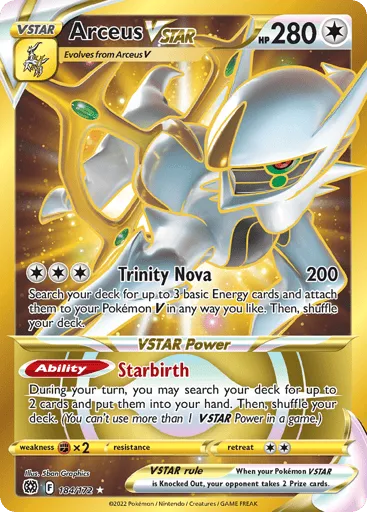
Gold Secret Rare
- Set
- Brilliant Stars
- Number
- 184/172
- Rarity
- Rare Secret
Check prices: eBay sold · TCGplayer
CardOps may earn a commission on purchases made through these links.
Market price via TCGplayer (through Scrydex); graded values via Scrydex. Card image via Scrydex. CardOps is an independent tool, not endorsed by any publisher or grading company.
Brilliant Stars put a gold secret rare at the top of its Trainer Gallery, and dealers have been moving raw copies cheap ever since. Here's why the number looks small until you factor in grading.
Arceus VSTAR's gold secret rare, number 184 out of a 172-card set, is the kind of card that confuses a new dealer: it's easy to find, it's cheap raw, and it still shows up on want lists. The reason is the grading spread. Raw copies trade like a common pull. Graded copies trade like a different card entirely. Knowing the gap is what lets you buy this one with confidence instead of passing on something you don't understand.
What it is
This is a VSTAR secret rare printed in a gold foil treatment, the kind of card sets started chasing after full-art alt arts proved collectors would pay a premium for a flashier version of a popular Pokémon. Arceus VSTAR plays a real deck role, which keeps a floor of player demand under it, and the gold stamping gives it a distinct look in a case next to the set's other secret rares.
Why it's a chase for some, a pass for others
At a raw market price in the high teens, this isn't a card that moves the needle on its own. What makes it worth stocking is the spread between raw and graded. A gem mint copy clears several times the raw price, and that gap is wide enough that dealers who grade in volume treat secret rares like this one as a standing submission candidate rather than a one-off. If you don't grade, it's still worth carrying as cheap chase-card inventory: low cost to hold, recognizable enough that it sells on sight.
How condition and grade move the number
A PSA 10 copy of this card has recently carried a market estimate of roughly $103, well above the raw figure. That's a real multiple, and it's the whole story with a card like this: the gold foil shows centering and surface issues clearly under a loupe, so condition does a lot of the work in deciding whether a copy is worth submitting at all. Check centering on both axes before you buy a stack of these for grading, and don't assume every raw copy you see is a candidate just because the card itself is in demand.
Demand has also been trending up: the 30-day trend on this card's raw market price runs around 12% higher than a month ago. That's a signal to watch, not a reason to chase the top of the range when you're pricing a buy.
Pricing it at a show
Price the raw copy to current comps, not to what a graded sale looks like on eBay. The two markets are only loosely connected at the point of sale: a buyer handing you cash at a table is paying for the raw card in front of them, not for its grading upside. If you're buying with an eye toward submission, build the grading fee and turnaround time into your math before you commit, and treat a confident PSA 10 call as the exception, not the plan.
Questions dealers ask
Is the price above current?
It's a dated market reference as of the date shown, not a live quote. Check recent comps for the exact variant and condition before you buy or sell.
Does grading change what this card is worth?
Yes, substantially. The gap between raw and a high PSA grade is large enough that many dealers treat this specific card as worth grading rather than selling raw. The figures above are a raw reference point and a dated graded estimate, not a guarantee of what a submission will come back as.