
Card spotlight
Arven (Scarlet & Violet): What It Is and What It's Worth
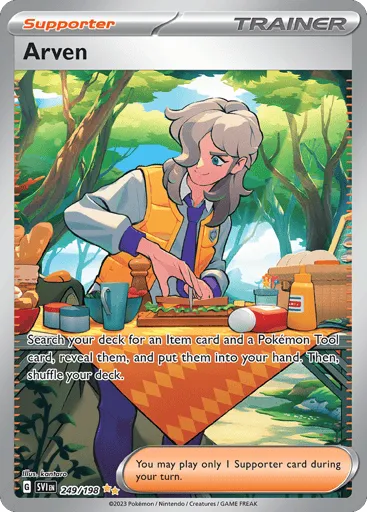
Special Illustration Rare
- Set
- Scarlet & Violet
- Number
- 249/198
- Rarity
- Special Illustration Rare
Check prices: eBay sold · TCGplayer
CardOps may earn a commission on purchases made through these links.
Market price via TCGplayer (through Scrydex); graded values via Scrydex. Card image via the card's image source (Scrydex for English cards, pokemontcg.io for older rows). CardOps is an independent tool, not endorsed by any publisher or grading company.
Arven's Special Illustration Rare from the Scarlet and Violet base set is a cheap pickup raw and a different animal graded. That gap is the whole lesson here.
Most of the cards worth a second look at a table are the obvious ones: the alt arts everyone already knows, the vintage holos with a name attached. Arven's Special Illustration Rare is the other kind. Raw, it sits in bulk-plus territory, cheap enough that a lot of dealers sort it into the dollar box without a second thought. Graded, especially at the top of the scale, it trades for multiples of that. Understanding why that spread exists, and when it is worth paying to find out, is a useful habit for any inventory that moves through modern Scarlet and Violet product.
What the card is
Arven is a Trainer card from the Scarlet and Violet base set, printed as a Special Illustration Rare at 249/198, an above-the-print-run slot reserved for full-art alternate takes on a set's cast. It is not a Pokemon and it is not the set's headline chase, but Special Illustration Rares as a category pull collector demand independent of competitive relevance; people chase the art and the slot, not the card's utility in a deck.
Why it is a chase for a specific buyer
Arven's SIR is not going to clear a table like a modern alt-art Charizard. Its audience is narrower: completionists working through a Scarlet and Violet master set, and collectors who like the character art regardless of rarity tier. That narrower demand is exactly why the raw price stays modest even as graded copies climb; the card needs a buyer who specifically wants a graded example to show the premium, and that buyer is not every buyer who walks past your case.
How condition and grade move the number
This is the card's real story. At TCGplayer market pricing, a raw holofoil copy runs a few dollars. A PSA 10, by contrast, carries a market estimate in the neighborhood of fifteen to twenty times that raw figure. That is an unusually wide spread for a card this inexpensive, and it is the kind of spread that only shows up on specific modern Special Illustration Rares where the raw population is large but a true gem-mint copy is comparatively rare.
The thirty-day trend on the raw price has drifted down, which matters for how you think about this card: the graded premium is not a reason to pay up on a stack of played copies hoping one grades. It is a reason to pay attention to centering and surface on the clean ones already sitting in your stock.
PSA 10 market est. ~$63 (via Scrydex, as of the date above). That is a market estimate, not a recent comp or a guaranteed grading outcome; treat it as context for deciding whether a copy is worth submitting, not as a number to quote a buyer for a raw card.
The case for grading a cheap card
Grading fees and turnaround time only make sense when the spread between raw and top-grade clears them with room to spare. A card worth a few dollars raw does not usually justify a grading submission on its own; the fee alone can exceed the card's value if it comes back anything less than a true gem. Where it starts to make sense is bulk submission: if you are already sending a batch of modern pulls to grading for other cards, a sharp-cornered, dead-centered copy of a card like this one costs you almost nothing extra to include, and a PSA 10 can turn a few-dollar card into a multiple of its raw price.
The flip side is just as real. A played or off-center copy of a cheap card is not worth grading on its own merits. Know your cost basis on cards like this before you decide whether a submission fee is a bet worth making.
Pricing it at a show
For a raw copy, price to the honest middle of recent comps for the exact printing and condition, the same method that works for every other card in your case. A few dollars is a few dollars; do not let a graded headline number talk you into pricing a played raw copy above what it will actually sell for. If a buyer is specifically asking about grading potential, that is a conversation about centering and surface, not about the price tag on the card in front of you.
Questions dealers ask
Is Arven's Special Illustration Rare worth grading?
Only selectively. The raw price is low enough that a single submission rarely pencils out on its own. It makes more sense as an add to a batch you are already sending in, where a sharp, well-centered copy has real upside if it comes back a PSA 10.
Why is the graded price so much higher than the raw price?
Special Illustration Rares from modern sets print in large numbers raw, but a true gem-mint copy, centered and clean under a grader's loupe, is comparatively scarce. That scarcity at the top grade, combined with collector demand for a graded slab, drives the spread.
Is the price above current?
It is a dated market reference as of the date shown, not a live quote. Always check recent comps for the exact printing and condition before you buy or sell.