
Card spotlight
Blastoise ex (151): What It Is and What It's Worth
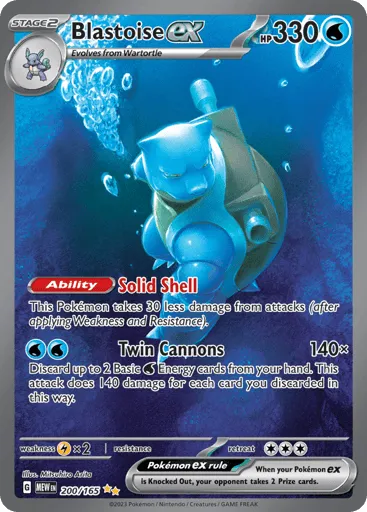
Special Illustration Rare
- Set
- 151
- Number
- 200/165
- Rarity
- Special Illustration Rare
Check prices: eBay sold · TCGplayer
CardOps may earn a commission on purchases made through these links.
Market price via TCGplayer (through Scrydex); graded values via Scrydex. Card image via Scrydex. CardOps is an independent tool, not endorsed by any publisher or grading company.
Every dealer who worked a table during the 151 release remembers the Charizard line. Fewer remember that Blastoise got the same illustration treatment, at a fraction of the price, and it has held up better than most of the set's other chase cards.
The 151 Blastoise ex Special Illustration Rare is the set's second-most-recognized SIR, sitting right behind its Charizard counterpart on most want lists. It never carried the same hype, which is exactly why it is worth understanding on its own terms. The pull rate, the printing, and the grading spread all set a different number than the card it gets compared to, and knowing that difference keeps you from either overpaying for a copy or underpricing one you already have.
What it is
Blastoise ex, number 200 of a 165-card base set, is a Special Illustration Rare from the 151 expansion. SIRs in this set use a full-bleed illustration with no visible border or text box, which is what separates them from the set's standard ex and regular illustration rare slots. The card has no alternate printing to confuse it with; any copy numbered 200/165 is the same illustration and rarity tier.
Why it trails Charizard
151's Charizard ex SIR became the set's headline card the day the set released, and that reputation pulled buyer attention and raw demand away from every other SIR in the set, Blastoise included. The two cards share a pull rate and a print run, so the gap between them is almost entirely demand, not scarcity. For a dealer, that gap is the opportunity: Blastoise is a genuine chase card at a price point a lot more buyers can actually say yes to.
How condition and grade move the number
A full-bleed illustration like this one shows edge wear and surface scratches more readily than a bordered card, because there is no border to absorb a buyer's eye away from a flaw. Centering is also a real variable on these SIRs; a copy that looks clean at arm's length can still miss on a close look. Grade honestly at the table and price a raw Near Mint copy accordingly. Population data on this card shows a large number of PSA 9 and PSA 10 copies already in the market, which is useful context: a high-grade raw copy is common enough that it is not, on its own, a reason to ask well above comps.
Pricing it at a show
The market figure above reflects a roughly 16 percent pullback over the trailing 30 days, which is typical for a modern chase card settling after its initial release window. Anchor your ask to recent sold comps for the exact printing, not to the highest active listing you can find, and recheck those comps periodically since a card still working through a post-release drift can move again. Keep your cost basis recorded in your inventory so a quick negotiation at the table never pushes you underwater.
Questions dealers ask
Is the price above current?
It is a dated market reference as of the date shown, not a live quote. Check recent comps for the exact printing and condition before you buy or sell, especially on a card that has been drifting over the past month.
Why is this worth so much less than the Charizard version from the same set?
Both cards share a print run and pull rate from the same set, so the gap comes almost entirely from collector demand, which concentrated on Charizard. Blastoise is the same rarity tier at a lower price point.
Does grading change what it's worth?
Yes, grade drives the number on a card like this. This snapshot is a raw reference point; a large population of high grades already in the market means a raw high-grade copy is not automatically rare.