
Card spotlight
Charizard-EX (Evolutions): What It's Worth and Why It Grades Well
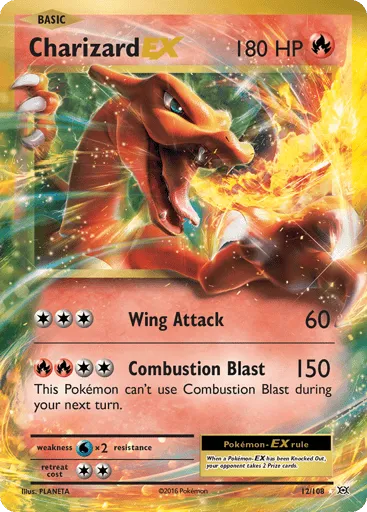
- Set
- Evolutions
- Number
- 12/108
- Rarity
- Rare Holo EX
Check prices: eBay sold · TCGplayer
CardOps may earn a commission on purchases made through these links.
Market price via TCGplayer (through Scrydex); graded values via Scrydex. Card image via the card's image source (Scrydex for English cards, pokemontcg.io for older rows). CardOps is an independent tool, not endorsed by any publisher or grading company.
Evolutions put a modern Charizard in front of a whole generation of collectors again. This one is cheap to buy raw and worth stocking anyway, because the grading spread does the heavy lifting.
Evolutions came out in 2016 as a 20th anniversary throwback, reprinting Base Set style art across a modern set. The Charizard-EX at number 12 of 108 was the set's headline pull, and it still shows up in bulk boxes and binders at nearly every show. It will not make you rich as a raw copy. What makes it worth knowing is the gap between what it sells for raw and what a clean copy brings back graded.
What this card is
Charizard-EX, Evolutions, number 12 of 108, Rare Holo EX. It is a modern holofoil, not a vintage Base Set print, so supply is large and the raw price reflects that. Evolutions was printed in volume to meet 2016 nostalgia demand, and this card was the chase pull of that set, which is why it still turns up constantly at tables years later.
Why dealers still care about it
A card does not need a four-figure raw price to be worth stocking. This one earns a spot in the case because of its grading story: a clean copy that comes back a PSA 10 is worth a real multiple of the raw price, and Evolutions holofoils are known for centering issues that keep gem-mint pulls from being common. That combination, a cheap buy-in and a real spread at the top grade, is exactly the setup that makes grading math worth running on a bulk pull.
How condition and grade move the number
Raw copies trade close to bulk holo pricing: minor whitening or a soft corner barely moves the number. The spread opens up once you cross into graded territory. On this card, a PSA 10 has recently traded for roughly 12 times the raw market price, and the gap is wider than the card's nostalgia alone would suggest, because so few copies clear a 10 on centering. Lower PSA grades, 8s and 9s, land in between and still beat raw by a solid margin. Before you submit anything, check the card under good light for centering and edge wear, since that is what separates a 10 from a 9 on this print.
Market has also drifted up a bit lately. The holofoil has moved roughly 6% higher over the past 30 days, which is normal month-to-month noise for a card this common and not a signal to chase.
Pricing it at a show
Price the raw copy to current comps, not to what the PSA 10 sells for. A buyer asking about grading potential is a buying signal, not a reason to mark up the raw card. If you pull a clean copy worth submitting, price it to hold rather than selling it off the table at bulk-holo money, and keep a note of your cost basis so you know your real margin once it comes back from grading. For a card like this, the profit is usually in the grading decision, not the raw sale.
Questions dealers ask
Is this Charizard worth grading?
It can be, if the copy looks clean under light: centered, sharp corners, no surface scratching. The raw to PSA 10 spread on this card is wide enough to justify a submission on a copy that has a real shot, but a played copy is better sold raw.
Is the price above a live quote?
No. It is a dated market snapshot as of the date shown, not a live price. Check recent comps for the exact condition before you buy or sell.
Why is a modern Charizard worth so little raw?
Evolutions printed in volume to meet 2016 demand, so raw supply is large. The card's value case is the grading spread, not raw scarcity.