
Card spotlight
Gengar (Fossil): What It Is and What It's Worth
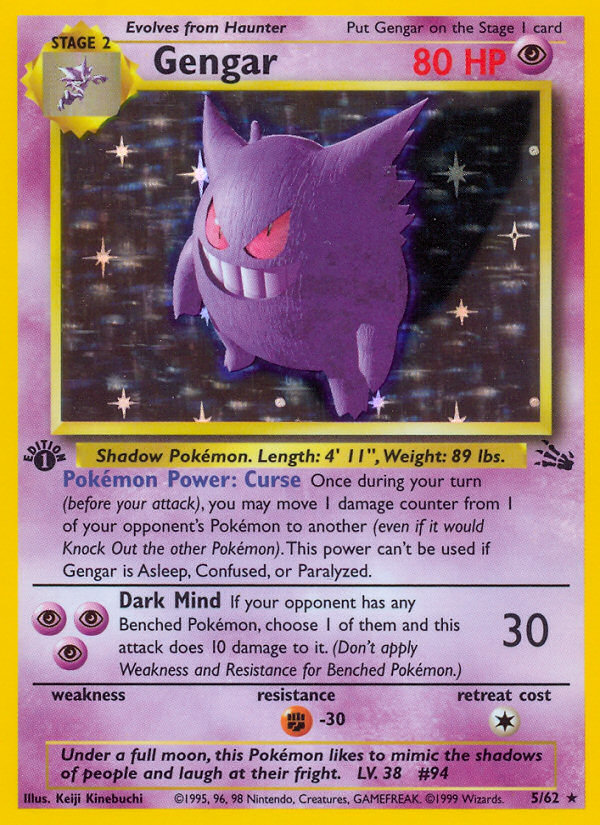
Holo Rare, Fossil 5/62
- Set
- Fossil
- Number
- 5/62
- Rarity
- Rare Holo
Market price via TCGplayer (through Scrydex); graded values via Scrydex. Card image via the card's image source (Scrydex for English cards, pokemontcg.io for older rows). CardOps is an independent tool, not affiliated with any publisher, marketplace, or grading company.
Fossil Gengar is one of the few 1999 holos that still walks up to the table on its own. Here is what the card is, why so many copies are worth less than the owner thinks, and how to price one without a long stare-down.
Every vintage seller ends up with a Fossil Gengar story. Someone hands you a binder page, the Gengar is the card they want quoted first, and the moment you tilt it toward the light the conversation changes. It is a genuinely popular 1999 holo with steady demand, and it is also a card whose print quality punishes casual sellers. Knowing both halves is what lets you buy it right and quote it fast.
What the card is
Gengar is card 5 of 62 in Fossil, the third English set of the original Wizards of the Coast run, released in 1999. It is a Holo Rare, so it came out of packs at roughly one per pack from the rare slot, and it arrived in two English printings: 1st Edition, marked with the small stamp under the art, and Unlimited, which has no stamp. There is no plain non-holo version of this card in the set, so any Fossil Gengar you are handed is a holo of one printing or the other.
The snapshot above is the Unlimited holo printing, which is the copy you will see far more often at a show.
Why it stays in demand
Gengar carries nostalgia weight that most Fossil holos do not. It was a card people actually wanted as kids, it plays into the ghost-type collector niche, and Fossil was a smaller set than Base, so the supply of clean copies is thinner than the raw print numbers suggest. The result is a vintage holo that keeps a real audience without needing a hype cycle behind it.
For a vendor that means predictable turnover. It is not a card you have to explain, which is worth something on a busy table.
Centering is the whole conversation
Fossil-era print runs were not kind, and Gengar is one of the worst offenders for centering. Copies routinely come out with the yellow border noticeably fatter on one side, top to bottom or left to right, and that alone caps what a copy is worth to a grader-minded buyer. Add the two other classic vintage problems, edge whitening on the black-heavy border and holo scratches across the foil window, and a card that looked fine in a binder page turns into a mid-grade copy under a loupe.
Check three things before you quote: centering front and back, whitening on all four edges, and surface lines across the holo. Say what you see out loud. A dealer who names the flaw first is trusted on the rest of the case.
First edition and unlimited are two different cards
Price them as separate line items, because the market does. In the same TCGplayer market snapshot behind the figure above, the 1st Edition holo sat around $601 while the Unlimited holo sat around $216 on 2026-09-10. Both are raw references, not live quotes, and both move.
The practical risk is the fast quote. If you price a stamped copy off an unlimited comp because you were in a hurry, you have just given away most of the card. Look for the stamp before the number leaves your mouth, and record the printing in your inventory so the mistake cannot repeat itself next show.
Pricing it at your table
Anchor to recent sold comps for the exact printing and condition, not to the most optimistic listing on the site. Over the last thirty days the unlimited holo has been essentially flat, which is a good reminder that vintage staples usually reward patience over reactive repricing.
Set a floor before the show, not during it. A card in this range gets haggled, and the answer to a lowball is easier when the number is already on the screen. Show Mode in CardOps keeps inventory search and market value by set and condition on the phone at the table, offline if the hall wifi gives out, so quoting a vintage holo does not turn into arithmetic in your head with a line waiting.
Questions dealers ask
Is the price above current?
It is a dated market reference for the raw unlimited holo as of the date shown, not a live quote. Vintage holos move with condition and with the week. Check recent sold comps for the exact printing and condition before you buy or sell.
How do I tell 1st Edition from Unlimited?
Look for the small 1st Edition stamp on the left side of the card, below the art and beside the Pokemon's stats. If there is no stamp, it is Unlimited. The two printings trade at very different levels, so confirm before quoting.
Is it worth grading?
That depends almost entirely on centering, and Fossil Gengar fails that test more often than it passes. Grading costs money and time per card, so it only makes sense on a copy that is clean on all four edges with a straight border. A graded copy trades on a different scale than raw, and the grade itself drives the number.