
Card spotlight
Gyarados (Base): What It Is and What It's Worth
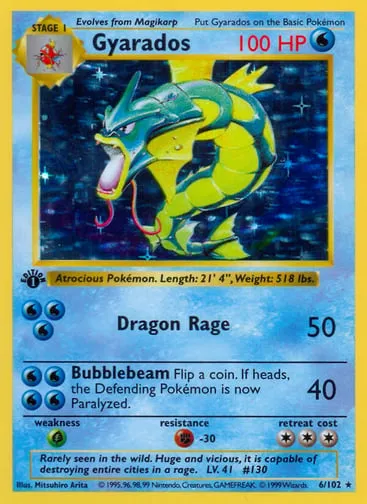
Rare Holo
- Set
- Base
- Number
- 6/102
- Rarity
- Rare Holo
Check prices: eBay sold · TCGplayer
CardOps may earn a commission on purchases made through these links.
Market price via TCGplayer (through Scrydex); graded values via Scrydex. Card image via Scrydex. CardOps is an independent tool, not endorsed by any publisher or grading company.
Not every holo in the case needs to be a four-figure grail to earn its spot. Base Set Gyarados is the card that gets a casual buyer to actually open their wallet.
Gyarados, number 6 of 102 in the 1999 Base Set, is not the card collectors drive across town for. It is the card that sells itself at a price a buyer can say yes to on the spot. If you work vintage at all, you have a handful of these in a box somewhere, and knowing what they are actually worth, not what you remember them being worth in 2021, keeps your case honest.
What it is
Gyarados is a Rare Holo from the original 1999 Base Set, the same era as Charizard, Blastoise, and Venusaur. It carries the standard Base Set holo pattern and stock. There is no alternate art or special illustration version of this printing to confuse it with; the variation that matters here is the print run, not the artwork.
Why it is the easy sell
Base Set holos split into a recognizable top tier, Charizard chief among them, and a wider second tier that includes Gyarados. It does not carry Charizard money, and that is exactly its value at a table: a real 1999 holo, from the set every buyer recognizes on sight, at a number a casual collector or a kid's parent can actually spend. It is a dependable mover rather than a headline piece, and a case with a few of these at an accessible price point closes more sales than a case stacked only with grails.
Why the printing changes the number
Base Set shipped in three relevant forms for this card: 1st Edition Shadowless, unlimited Shadowless, and plain unlimited, and they do not trade anywhere near each other. TCGplayer market on unlimited holofoil currently runs about $48. The Shadowless unlimited print, the no-rarity-symbol version from the first print run before the shadowless stamp was dropped, prices closer to four figures, and 1st Edition copies price higher still. There is no single plain holofoil number that covers all of that; quoting a figure for this card without naming which printing you are holding is the single fastest way to misquote it in either direction. Check the card back and the rarity symbol before you say a number out loud.
How condition and grade move value
At nearly 27 years old, raw copies show their age: edge wear, whitening, and surface scratches are common, and they stack up fast against a $48 base. A clean raw copy near the top of condition supports the market reference above; a heavily played one is worth a fraction of it. Grading spreads wide on this card the higher up the scale you go, since a true gem-mint vintage copy is scarce next to the raw supply still sitting in old collections. Grade it honestly in front of the buyer. Anyone who has handled vintage before will spot a soft corner, and pricing past it just kills the sale.
Pricing it at a show
Confirm the printing first: Shadowless or not, 1st Edition stamp or not, before you quote anything, since that alone changes the number by an order of magnitude. From there, anchor to recent sold comps for that exact printing and condition rather than a number you remember from a few years back; vintage comps drift more than people expect. If the copy in front of you is rough, price it as a played common-print holo, not a near-mint one with a discount tacked on. Comp-based pricing works the same here as it does on anything else in the case: real recent sales, not nostalgia.
Questions dealers ask
Is $48 the price I should quote?
It is a dated market reference for a raw, unlimited holofoil copy as of the date shown, not a live quote. Confirm the printing, since Shadowless and 1st Edition copies price far above this, and check recent comps for the exact condition before you buy or sell.
Why does the same card have such different prices?
Base Set printed in stages, and the printing, not the artwork, is what the market is actually pricing. Plain unlimited, Shadowless unlimited, and 1st Edition are effectively three different cards commercially even though they look nearly identical. Always check the back and the rarity symbol before pricing a copy.
Is this card worth stocking?
Yes, as a volume mover rather than a grail. It is recognizable, affordably priced in its common printing, and tends to close a sale with buyers who are not shopping for a four-figure card that day.