
Card spotlight
Typhlosion (Neo Genesis): What It Is and What It's Worth
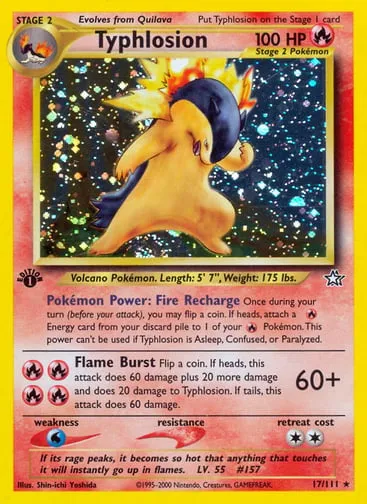
Holo Rare
- Set
- Neo Genesis
- Number
- 17/111
- Rarity
- Rare Holo
Check prices: eBay sold · TCGplayer
CardOps may earn a commission on purchases made through these links.
Market price via TCGplayer (through Scrydex); graded values via Scrydex. Card image via the card's image source (Scrydex for English cards, pokemontcg.io for older rows). CardOps is an independent tool, not endorsed by any publisher or grading company.
Typhlosion never got the hype of Base Set's big three, but a clean Neo Genesis holo of it still earns a case slot. Here is what drives the number, and the one detail that trips up new sellers.
Neo Genesis brought the Johto starters to the table for the first time, and Typhlosion's holo rare has aged into a quiet vintage staple. It will never carry Charizard money, but it moves steadily, and vendors who don't check which printing they're holding routinely misprice it. Here is what the card is, why it holds a line in a vintage case, and how to put a number on it at your table.
What the card is
This is the Typhlosion holo rare from the 2000 Neo Genesis set, numbered 17 out of 111. It was the only Typhlosion printed in that set and one of the few fire-type holos from the early Neo era, which keeps it on vintage want lists even though it never saw competitive play.
Why it's a chase, if a quiet one
Neo Genesis sits in the same vintage window as Base Set and Jungle, and the starter evolutions from that set carry nostalgia for the players who opened packs of it as kids. Typhlosion doesn't headline the set the way its box art or the legendary birds do, but a clean copy still sells reliably to collectors finishing a Johto run or a full Neo Genesis set. Steady demand with limited new supply is what keeps a secondary card like this from fading.
The printing split that changes the price
Neo Genesis predates the plain holofoil printing most modern sets use. This card only comes in two forms: a 1st Edition holofoil, marked with the 1st Edition stamp, and a far more common unlimited holofoil without it. The gap between them is large, not a rounding error, so always confirm which stamp (or lack of one) is on the card in your hand before you quote a price. The figure above is for the unlimited printing, the one most vendors see at a table. A 1st Edition copy prices on an entirely different scale and should never be quoted off this number.
How condition and grade move it
Vintage holos from this era show their age fast: edge whitening, print lines, and surface scratches are common even on cards that were never played. Centering is usually the first thing a buyer checks on a Neo Genesis holo, since many copies from this set run off-center from the factory. A graded copy trades on its own scale entirely, separate from a raw card, and the grade itself is most of what sets the price. Treat any raw number, including the one above, as a Near Mint reference point rather than a price for a card with visible wear.
Pricing it at a show
Start from recent sold comps for the exact printing, not the first listing you find, and confirm which holofoil variant you're holding before you anchor to any number. A buyer who knows the set will ask about the stamp before they ask about price, and quoting the wrong printing's figure either scares off a fair offer or leaves money on the table. Keep your cost basis handy so a round of haggling on a vintage piece like this never pushes you below your floor.
Questions dealers ask
Is the price above a live quote?
No. It's a dated market snapshot as of the date shown, for the unlimited holofoil printing specifically. Always check current comps for the exact printing and condition before you buy or sell.
Does the 1st Edition stamp really matter this much?
Yes. On Neo Genesis holos, the 1st Edition printing and the unlimited printing are priced on different scales, not a small premium. Confirm the stamp before quoting either direction.
Does grading change what it's worth?
Significantly. A graded copy sells on its own scale, driven mostly by the grade itself. The figure in this spotlight is a raw reference point, not a graded one.