
Card spotlight
Charizard ex (Paldean Fates): What It's Worth
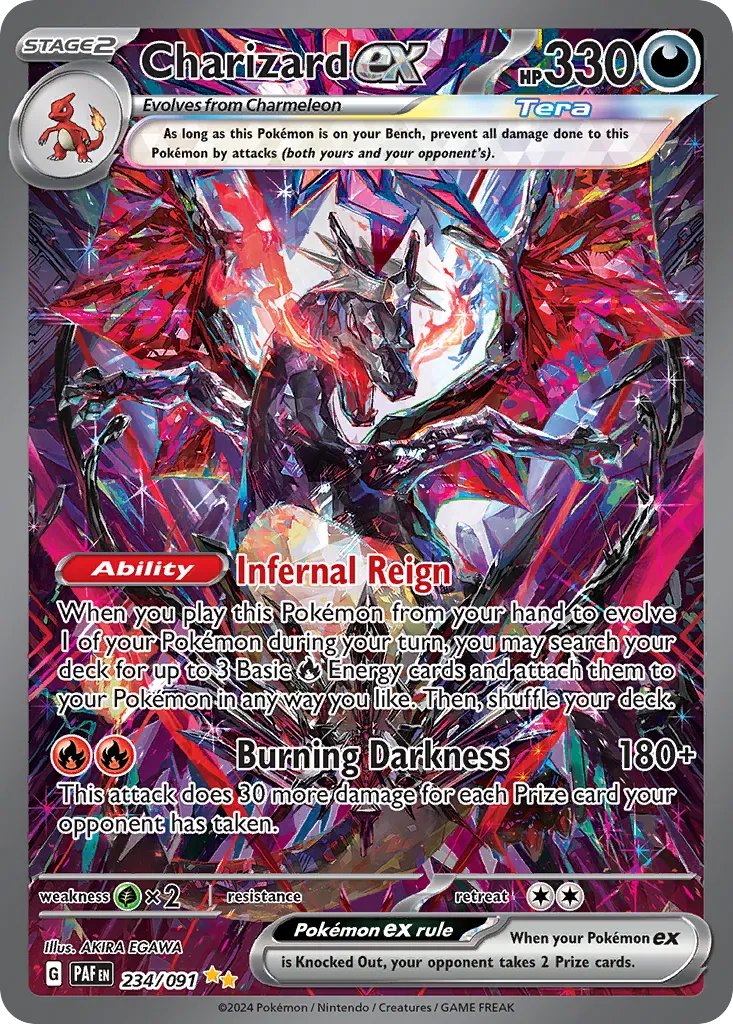
Special Illustration Rare
- Set
- Paldean Fates
- Number
- 234/091
- Rarity
- Special Illustration Rare
Market price via TCGplayer (through pokemontcg.io); graded values via Scrydex. Card image via pokemontcg.io. CardOps is an independent tool, not affiliated with any publisher, marketplace, or grading company.
Every shiny set gets one card that pays for the box, and in Paldean Fates it is the Charizard ex Special Illustration Rare. Here is what it is, and how to price it without guessing.
Paldean Fates landed in early 2024 as a shiny-heavy special set, and the card everyone opened for was the Charizard ex Special Illustration Rare, number 234 of a printed 91. If you work shows, you have already sold one or turned one down in a collection buy. Modern chases like this move faster than vintage does, so the useful question is not what it peaked at. It is what it trades for this week, and what a buyer at your table will actually pay.
What the card actually is
Special Illustration Rare is the top illustration tier in the Scarlet and Violet era. The number sits above the printed set total, so 234/091 tells you it is a secret slot pulled at a much lower rate than the base rarities. Paldean Fates was a shiny set with a short print window, which stacked collector demand for the whole product on top of the usual Charizard premium.
Two practical notes for the case. There is one English printing to worry about here, so you are not sorting variants the way you would on a Base Set holo. And the artwork runs edge to edge, which means surface and edge wear show immediately under a light.
Why it became a chase
The recipe is familiar: the most recognizable Pokemon in the hobby, the highest illustration rarity in the set, and a special-set print run that stopped while demand was still climbing. Modern chases do not need decades of nostalgia to hold a number. They need a card that people who do not play the game still want to own, and this one clears that bar in a case at ten feet.
It also draws foot traffic. A recognizable Charizard in the front row of your case starts conversations that end on other cards, which is worth something even on the days it does not sell.
What the snapshot says right now
The figure in the block above is the TCGplayer market price for a raw holofoil copy on the date shown. It is a dated reference point, not a live quote, and not the highest listing on the site. Over the last 30 days that market number moved down roughly 5 percent, which is normal drift for a modern chase and not a signal on its own.
Graded copies trade on a different scale. As of the same snapshot the PSA 10 market estimate sits around $801. Treat that as an estimate rather than a sale: it is a smoothed number that lags a hot week in either direction, and it is not what a raw copy in your case is worth. Quote raw against raw.
How condition and grading move the number
On a full-art modern card the gap between a clean copy and a lightly played one opens fast, because buyers at this price point are comparing against submission odds, not against playability. Check four things under good light before you price it: centering front and back, edge whitening on the dark borders, surface scratches across the foil, and any print line running through the art.
If the copy is clean, the raw market number is a fair anchor and you can hold near the top of your range. If it has a soft corner or visible whitening, say so out loud and price it under the anchor. A dealer who names the flaw before the buyer finds it closes more of these than one who hopes the light stays dim.
Pricing it at a show
Anchor to recent sold comps for this exact printing and condition, then adjust for your fees and the day. Booth rent, card processing, and the trip do not disappear because the card is expensive, so build them into the floor before you start negotiating rather than after.
Write down cost and floor for a card at this level and keep them where you can see them mid-conversation. In CardOps the scanner pulls the card up with its live market value attached, and Show Mode keeps your running per-show profit on screen while you sell, so a friendly haggle on one card does not quietly push the table underwater. Whatever you use, the rule is the same: know your floor before the buyer asks.
Questions dealers ask
Is the price shown current?
It is a dated market reference from the date printed in the block above, not a live quote. Modern chases move week to week, so check recent comps for this exact printing and condition before you buy or sell.
What does 234/091 mean?
The card number sits above the printed set total, which marks it as a secret rare slot beyond the numbered set. Those slots are pulled at a much lower rate than the base rarities, which is a large part of why the card carries a premium.
Is it worth grading?
That depends on the copy and on grading cost, not on the card. The graded figure quoted above is an estimate for a top grade, and most raw copies do not get there. Look hard at centering and surface first, and price the submission fee and turnaround into the decision.
How do I price one I took in on a collection buy?
Value it at the raw market for its real condition, not at the graded estimate, and record what you paid for it separately from the lot. Cost basis on a card at this level is what tells you later whether the whole buy actually made money.