
Card spotlight
Iono Special Illustration Rare: What It's Worth
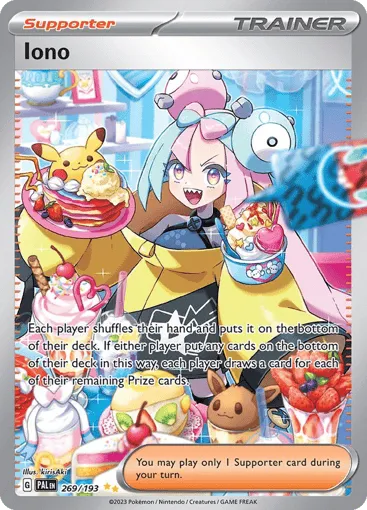
Special Illustration Rare
- Set
- Paldea Evolved
- Number
- 269/193
- Rarity
- Special Illustration Rare
Market price via TCGplayer (through Scrydex); graded values via Scrydex. Card image via the card's image source (Scrydex for English cards, pokemontcg.io for older rows). CardOps is an independent tool, not affiliated with any publisher, marketplace, or grading company.
Iono is a Trainer, not a Pokemon, and this card still sells like a headliner. Here is what it is and how to think about its value at your table.
Paldea Evolved's Iono Special Illustration Rare is the card that got a lot of dealers to stop skipping the Supporter section of a set when they price a box. It is not a Pokemon, it is not a Charizard, and it still trades in a range that competes with the chase Pokemon from the same set. If you work shows, understanding why it holds value helps you buy it right and price it with confidence when it shows up in a lot.
What it is
Iono, number 269 out of a 193-card printed total, is the Special Illustration Rare version of the Trainer card from Paldea Evolved. Like the rest of the SIR tier in the Scarlet and Violet era, it swaps the standard game art for a full-bleed illustration that extends past the card frame, which is why it reads more like a print than a playing piece.
Why a Trainer card is a chase
The modern illustration-rare tiers changed what counts as a chase card. Collectors are buying the art and the character, not just the Pokemon on the front. Iono is a popular character with a striking full-art treatment, and the SIR print run sits in the same scarce slot as the set's other illustration rares, so demand from both players building around the character and collectors chasing the art stacks on a limited supply. That is the same demand-against-scarcity pattern that drives value in the game's biggest Pokemon chase cards, just applied to a Trainer.
How condition and grade move the number
Centering matters more on a full-art illustration than on a standard card, since the extended art makes any off-center print obvious at a glance. Edge whitening and surface scratches show up fast against the busy background too. A raw Near Mint copy anchors near the top of the raw range; anything with visible print lines, whitening, or a soft corner should be priced down from there, not hoped past a buyer.
Grading widens the gap further. A PSA 10 of this card has recently carried a market estimate in the neighborhood of $134, several times the raw holofoil figure above. That is an estimate built from Scrydex's graded pricing data, not a live quote or a guaranteed sale price, and it moves with recent comps like any graded market. Treat it as context for what a submission could be worth, not a number to promise a buyer.
Pricing it at a show
Anchor to recent sold comps for the exact printing and condition, not to the highest listing you can find online. Trend data on this card has run slightly soft over the past month, so check whether a listing you are pricing against is a recent sale or an old ask before you use it as your number. Keep your cost and floor recorded on the card so a friendly negotiation at the table never pushes you underwater on a piece this valuable.
Questions dealers ask
Is the price above current?
It is a dated market reference as of the date shown, not a live quote. Check recent comps for the exact printing and condition before you buy or sell, especially on a card whose trend has been moving.
Why is a Trainer card worth this much?
Modern illustration-rare tiers put Trainer cards in the same scarce print slot as the set's Pokemon chase cards. Collectors buying the art and the character drive demand independent of whether the card features a Pokemon.
Does grading change what it's worth?
Yes, significantly. A graded copy trades on a different scale than raw, and the grade itself drives the number. The snapshot above is a raw reference point; the graded figure in this guide is a market estimate, not a guaranteed sale price.