
Card spotlight
Alakazam (Base): What It Is and What It's Worth
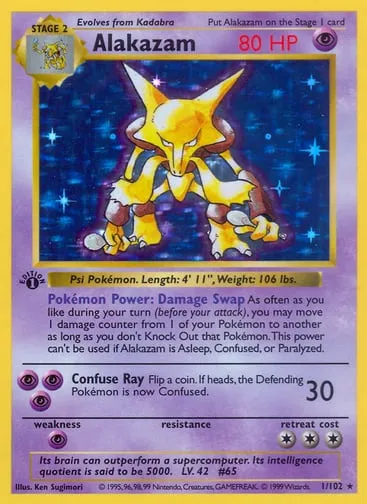
Holo Rare
- Set
- Base
- Number
- 1/102
- Rarity
- Rare Holo
Market price via TCGplayer (through Scrydex); graded values via Scrydex. Card image via the card's image source (Scrydex for English cards, pokemontcg.io for older rows). CardOps is an independent tool, not affiliated with any publisher, marketplace, or grading company.
It's card 1 of 102 in the set that started the market, and it never gets the line that Charizard does. Here's what a Base Set Alakazam is and how to think about pricing one.
Alakazam sits at the very front of the 1999 Base Set numbering, one of the original sixteen holo rares alongside Blastoise, Venusaur, and Charizard. It doesn't carry their name recognition, and it doesn't need to. It's a genuine vintage holo from the set that built the hobby, it's still easy to find, and it still sells. For a dealer who wants real Base Set stock in the case without tying up a lot of cash in one card, it's worth knowing.
What it is
Alakazam is a Stage 2 Psychic-type, evolved from Kadabra, and one of the sixteen holo rares printed across the 1999 Base Set's 1st Edition and Unlimited runs. The holo rares in that set were numbered alphabetically, which is why Alakazam lands at 1/102 even though it isn't the set's biggest name. It shares a print run with Charizard and Blastoise, just without the demand that follows those two everywhere they go.
Why it still moves at a table
Buyers who collect Base Set don't stop at Charizard. A full run of the sixteen original holos is a common collecting goal, and Alakazam is one of the cards that goal requires. It's also a way into vintage for a buyer who isn't ready to spend Charizard money: real 1999 cardstock, a real holo pattern, at a price that doesn't need a conversation about payment plans. That combination is why it keeps changing hands at shows even though it rarely headlines a case.
- Set completionists need it regardless of price
- New vintage buyers use it as an entry point
- Dealers use it as accessible stock that still carries Base Set's brand
How printing and condition move the number
Base Set holos come in more than one printing, and the gap between them is real. Unlimited copies are the ones most dealers see and price day to day. First Edition and Shadowless copies of the same card trade well above Unlimited, sometimes several times over, because the print runs were smaller and collectors specifically hunt the earlier ones. Get the printing wrong on an intake ticket and you've mispriced the card, not just misjudged its condition.
Condition matters just as much within a single printing. Twenty-six years of handling means most surviving copies show some whitening on the edges, a soft corner, or print-line texture in the holo foil that vintage cards are known for. A clean, well-centered Unlimited copy sells at the top of its range; a beat one sells well below it, even before grading enters the conversation. Note the printing and the condition honestly when you take a card in, because both change what number you write on it.
Pricing it at a show
The snapshot above is a raw, Unlimited holofoil reference as of the date shown, not a live quote. Check it against recent comps for the exact printing before you buy or sell, especially if the copy in your hand looks like it could be First Edition or Shadowless. Low-dollar vintage like this is easy to under-price out of habit, since a quick glance can make it look like any other common holo.
It's also easy to lose track of at scale. A dealer running a full Base Set run in the case benefits from logging each card by its actual printing rather than lumping them together. CardOps' scanner matches a card against a 20,000+ card catalog and attaches a live market value by set and condition, so a stack of vintage holos gets priced and logged in seconds instead of a guess at the table.
Questions dealers ask
Is the price above current?
It's a dated market reference as of the date shown, not a live quote. Vintage prices move slower than modern chase cards but they still move, so check recent comps for the exact printing and condition before you commit.
Why is Alakazam worth so much less than Charizard from the same set?
Both are original Base Set holos from the same print run, but demand is driven by name recognition and collector demand, not scarcity alone. Charizard pulls buyers who don't collect anything else in the set; Alakazam mostly sells to people building a complete run or starting in vintage.
Does the printing really change the price that much?
Yes. First Edition and Shadowless copies of the same Base Set card typically trade well above the Unlimited printing most dealers see day to day, because far fewer of them were made. Confirm which printing you're holding before you price it.