
Card spotlight
Blaine's Charizard (Gym Challenge): What It Is and What It's Worth
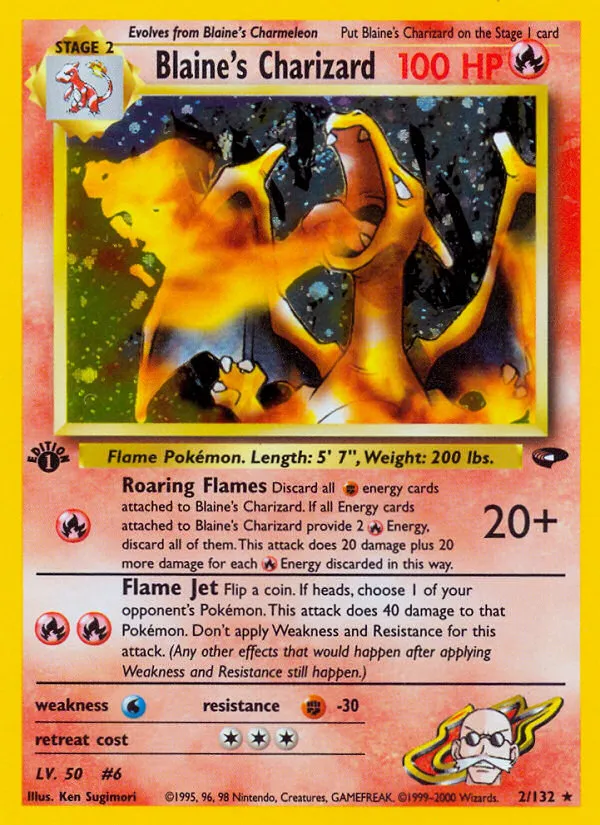
Rare Holo
- Set
- Gym Challenge
- Number
- 2/132
- Rarity
- Rare Holo
Market price via TCGplayer (through pokemontcg.io); graded values via Scrydex. Card image via pokemontcg.io. CardOps is an independent tool, not affiliated with any publisher, marketplace, or grading company.
When a buyer walks up asking for a vintage Charizard and Base Set is out of their budget, this is the card you reach for. Here is what it is and how to price one honestly.
Blaine's Charizard is the holo rare that opens Gym Challenge, the second of the two Gym-era sets Wizards of the Coast put out in 2000. It sits in a useful spot in a vintage case: recognisably a Wizards-era Charizard, wanted by the same people who chase Base Set, but trading well below it. That also makes it one of the easiest vintage cards to misprice, because the number swings hard on which printing you are holding.
What the card actually is
Gym Challenge closed out the Gym block, the sets built around Gym Leaders and their Pokémon. Blaine's Charizard is card 2 of 132, a Rare Holo, and it is the marquee card of the set the way Charizard is the marquee card of Base.
Two things about it matter when you buy: it is a Wizards-era holo, so it carries all the print quirks of that period, and it was printed in both a 1st Edition run and an Unlimited run. Buyers who ask for "the Gym Charizard" often do not specify which, and the gap between them is not small.
Why it stays in demand
The demand here is mostly nostalgia plus a budget ceiling. A collector who wants a 1999 to 2000 Charizard in a binder, and who is not going to spend Base Set money, lands on this card. It reads as vintage at a glance: the holo pattern, the Wizards logo, the era-correct frame.
The set itself helps. Gym Challenge was printed in smaller quantities than Base Set and its reprints, so clean copies do not turn up in every collection that walks past your table. That is a steadier kind of demand than a modern chase, which is worth knowing when you decide how long you are willing to sit on one.
The printing decides the price
This is the part to get right before you quote anything. The 1st Edition printing carries the stamp on the left of the artwork; the Unlimited printing does not. They are different cards as far as the market is concerned, and they carry separate price data.
The snapshot above is the Unlimited Holofoil printing, raw. Do not apply it to a 1st Edition copy, and do not let a seller apply a 1st Edition ask to an Unlimited card you are buying. Check the stamp with the card in your hand, in good light, before a number leaves your mouth. If you are not sure, say you are not sure and price to the safer of the two.
How condition and grading move the number
Wizards-era holos are unforgiving. Centering is the usual killer on this card, and the holo foil scratches and shows edge whitening in a way modern print runs do not. A copy that looks fine in a sleeve at arm's length can be a long way off Near Mint under a light.
The grading spread reflects that. As of 21 August 2026, the PSA 10 market estimate sat around $17,600, against roughly $602 for a raw Unlimited copy. Treat that as direction, not a quote. It is a smoothed estimate that can lag hot sales, it is not split by printing, and the population that reaches PSA 10 on a card like this is tiny. The relevant lesson for a vendor is the shape, not the figure: a top-grade copy trades on a completely different scale, so the moment a raw copy looks genuinely clean it deserves a second look before it goes in the case at raw money.
Over the last 30 days the raw Unlimited market has been essentially flat, which is typical for vintage of this tier. It moves on the quarter, not on the week.
Pricing one at a show
Work in this order. Identify the printing. Grade the copy honestly, out loud, naming the flaws you can see. Then anchor to recent sold comps for that exact printing and condition, not to the most optimistic listing on the shelf.
Vintage Charizards attract padded asks, and a buyer who has been quoted a fantasy number at the last three tables will remember the dealer who told them plainly what their card was. Keep your cost and your floor recorded so a friendly haggle at the end of a long day does not quietly put you underwater. CardOps totals your per-show profit live in Show Mode, which is the fastest way to notice that the case is moving but the day is not actually making money.
Questions dealers ask
Is the price above current?
It is a dated market reference for one printing, taken on the date shown, not a live quote. Vintage moves slowly but it does move. Check recent comps for the exact printing and condition before you buy or sell.
How do I tell 1st Edition from Unlimited?
Look for the 1st Edition stamp to the left of the artwork, below the illustration box. Unlimited copies have no stamp. The two printings carry separate prices, so confirm which one you have before quoting.
Is it worth grading?
Only if the copy is genuinely clean. Centering and holo scratches sink most Wizards-era submissions, and grading fees plus shipping come off the top whatever grade comes back. Assess it honestly first, and remember that any pre-submission estimate is an estimate, not an appraisal.