
Card spotlight
Base Set Venusaur 15/102: What It's Worth
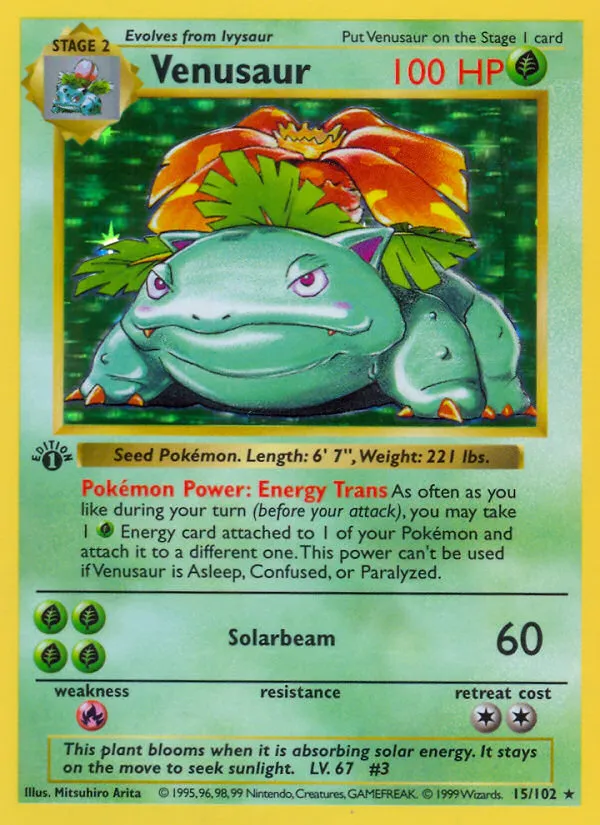
Base Set Holo Rare
- Set
- Base
- Number
- 15/102
- Rarity
- Rare Holo
Market price via TCGplayer (through pokemontcg.io); graded values via Scrydex. Card image via pokemontcg.io. CardOps is an independent tool, not affiliated with any publisher, marketplace, or grading company.
Every Base Set case has one of these sitting behind the Charizard. It is the holo dealers price fastest and think about least, and that is exactly where money leaks.
Venusaur 15/102 is the third starter holo in the 1999 English Base Set, alongside Charizard 4/102 and Blastoise 2/102. It carries none of the Charizard noise, which is why a lot of tables treat it as a filler holo and quote it from memory. That habit is expensive. Base Set holos are printing-sensitive and condition-sensitive, and a copy you wave through at a round number can be worth several times what you said.
Here is what the card is, what the dated snapshot above actually represents, and how to price one at the table without slowing your line down.
What the card actually is
Venusaur is the final evolution of the Kanto grass starter and one of sixteen holo rares in the English Base Set. Black border, holo pattern across the artwork window, card 15 of 102 in the set list. It sat in the first English set most collectors ever opened, which is why demand for it never fully goes away, even in a slow market.
Three things follow from that for a vendor:
- It is a set-completion card. Buyers working through Base Set need it, and they will pay a fair number for a clean copy rather than wait for the next show.
- It is old enough that condition varies wildly. A 1999 holo has had twenty-six years to pick up edge wear, and most copies show it.
- It exists in more than one printing, and the printings do not trade anywhere near each other.
None of that is exotic knowledge. It is just the checklist most people skip when the card is not a Charizard.
Why dealers underprice it
The pricing anchor at a Pokemon table is Charizard. Buyers ask for it, dealers quote it, and every other Base Set holo gets sorted mentally as "the cheap ones." Venusaur lands in that bucket by default, even though it is the second or third most requested card in the set depending on the room.
The other reason is speed. On a busy Saturday you are pricing from a glance, and a glance cannot tell you whether the copy in your hand is a common later printing or an early one. So the safe number wins, and the safe number is always low.
The fix is not to slow down. It is to check one thing before you quote, every time: which printing is this. That single question is worth more per weekend than any other pricing habit on a vintage table.
What the snapshot above says
The figure in the panel is TCGplayer market for a raw holofoil copy, dated 5 September 2026. Two words in that sentence carry all the weight.
Market means a smoothed figure derived from what copies have recently been selling for. It is not the cheapest listing, it is not the highest ask, and it is not a max. Someone will always show you a screenshot of a higher number; that is a listing, not a sale.
Raw means ungraded. A slabbed copy trades on a completely separate scale, and the gap between raw and a high grade on a 1999 holo is not a multiplier you can apply in your head. Do not convert one into the other at the table.
Treat the snapshot as a reference point for the common printing in average collected condition, then adjust up or down from there for what you are actually holding. It is dated on purpose. A number without a date is a rumor.
Printing and condition move the number more than the card does
Two copies of Venusaur 15/102 can sit side by side on your table and belong in different price tiers. Work down this order.
Printing first
The English Base Set ran through more than one printing, and the earlier ones command a large premium over the later, widely available ones. Confirm which one you have before you quote anything. If you are unsure, say so and price conservatively rather than guessing high and walking it back in front of a buyer.
Then centering
Base Set holos are notorious for drifting borders. Centering is the first thing a grader penalizes and the first thing an experienced buyer checks, so it belongs in your quote, not in the fine print.
Then surface and edges
Hold the holo layer to the light. Scratches across the foil are extremely common and are usually what separates a strong raw copy from an average one. Then check the black border for whitening, since black shows every nick, and flip it over for back wear and print lines.
Then grading, separately
Grading is its own decision with its own costs and turnaround. High grades on 1999 holos are genuinely scarce relative to how many have been submitted, which is why the top of that market runs so far ahead of raw. If you are stocking to grade, price the raw copy as raw and let the grading math be a separate conversation.
Write your condition read down when you buy the card, not when you sell it. The note you make with the card in hand is the one you will trust three shows later.
Pricing it at a show
A workable table routine for a card like this takes about twenty seconds:
- Identify the printing.
- Pull a market reference for that exact printing and condition, not for the card in general.
- Adjust for centering, holo scratches, and border whitening, and say your reasoning out loud. Buyers trust a quote they can follow.
- Check the number against your cost and your floor before you agree to anything.
- Log the sale with the condition note attached, so next month's pricing starts from real history instead of memory.
This is the part CardOps was built for. Scan the card, get a market value by set and condition, and keep the whole thing running on the device when the hall wifi gives out. Your cost basis and per-show profit update as you sell, so the margin question is answered before you pack up, not the following week in a spreadsheet.
The habit matters more than the tool, though. Check the printing, read the condition honestly, quote from comps for the exact copy in your hand. Do that on the cards nobody is excited about, and the quiet holos in your case stop being the ones you lose money on.
Questions dealers ask
Is the price above current?
It is a dated market reference for a raw holofoil copy as of the date shown, not a live quote. Vintage holos move with demand and with which printings surface at auction, so check recent comps for your exact printing and condition before you buy or sell.
Does it matter which printing I have?
Yes, more than anything else about the card. The English Base Set had multiple printings and they trade in different tiers. A quote given without identifying the printing is a guess.
What is a graded copy worth?
Something entirely different, and not a fixed multiple of the raw number. Grade drives the value on a 1999 holo, and high grades are scarce, so a slab needs its own comps for that exact grade and grading company.
Is Venusaur worth stocking if Charizard sells first?
It is. Set-completion buyers need every holo in the set, and the ones that get overlooked at other tables are usually the ones you can buy right. The margin is in pricing it properly, not in hoping it turns over as fast as Charizard.