
Card spotlight
Blastoise (Base): What It Is and What It's Worth
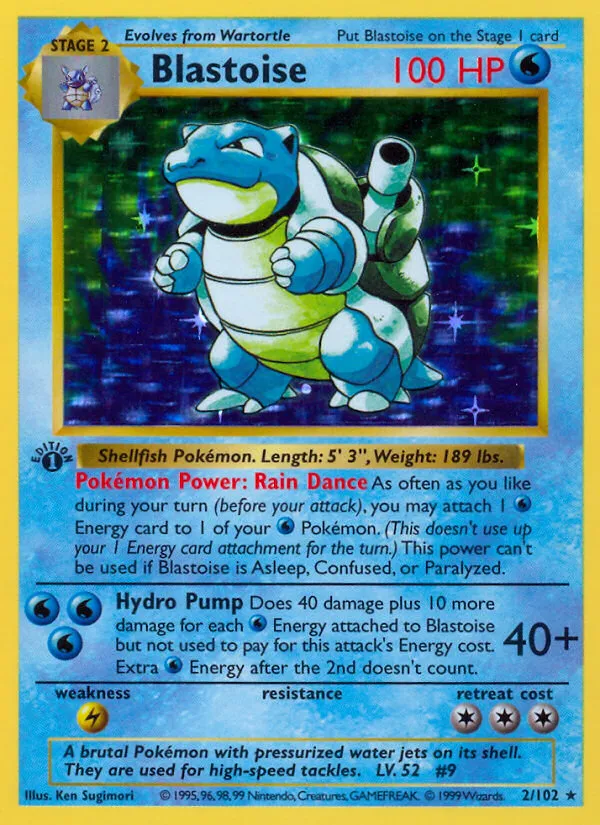
Holo Rare
- Set
- Base
- Number
- 2/102
- Rarity
- Rare Holo
Market price via TCGplayer (through pokemontcg.io); graded values via Scrydex. Card image via pokemontcg.io. CardOps is an independent tool, not affiliated with any publisher, marketplace, or grading company.
It never gets the line at your table that Charizard does, but Base Set Blastoise still moves, and buyers who know the set look for it specifically. Here is what it is and how to price it.
Blastoise sits at 2/102 in the 1999 Base Set, the same holo run that produced Charizard and Venusaur. It was the artwork on the original Base Set booster box, which gives it a recognition edge that a lot of other vintage holos don't have. It's usually the second card a buyer asks about after Charizard, and it's worth stocking with the same care.
What makes it a Base Set staple
Blastoise is one of the original 16 Base Set holos, printed in both 1st Edition and Unlimited runs (and, on the 1st Edition side, both shadowless and non-shadowless variants). It's part of the trio collectors call the Base Set starters' final forms, alongside Charizard and Venusaur, and it was the featured artwork on the original booster box art. That box-art status keeps demand steady even when it isn't the flashiest card in a case.
Why it trades in Charizard's shadow
Charizard pulls the spotlight and, with it, most of the speculative demand. Blastoise moves on steadier, more collector-driven interest, which tends to make it less volatile round to round. For a vendor, that can be an advantage: it's a card you can price confidently off recent comps without chasing a hype swing.
How condition and grade move the number
Vintage holos are unforgiving on centering, edge whitening, and surface scratches, and Blastoise is no exception. The raw market snapshot above reflects an ungraded copy; a clean, well-centered example can sell above it, while visible wear pulls it down fast. Graded copies trade on an entirely different scale. A PSA 10 Blastoise from this print run has sold for well into five figures, while mid-grade copies (PSA 5-7) land far closer to the raw number. Always separate 1st Edition from Unlimited and shadowless from non-shadowless when you're comping a specific copy; the print variant changes the math as much as the grade does.
Pricing it at a show
Anchor to sold comps for the exact print run, edition, and condition, not the highest listing you can find. The market has drifted down slightly over the trailing month, so lean on recent sales rather than an older number stuck in your head. Keep your cost basis and floor written down before the show starts so a slow morning doesn't talk you into a price you'll regret by the afternoon.
Questions dealers ask
Is the price above current?
It's a dated market reference as of the date shown, not a live quote. Check recent sold comps for the specific print run and condition before you buy or sell.
Does 1st Edition change the value?
Yes, substantially. 1st Edition and shadowless copies trade well above Unlimited, and the snapshot above reflects the more common holofoil listing, not a 1st Edition premium. Confirm the exact print variant before pricing a specific copy.
Is a graded copy worth more than the raw number here?
Almost always, and the gap widens sharply at the top grades. A raw copy and a PSA 10 of the same card are effectively different markets.