
Card spotlight
Charizard ex (151): What It Is and What It's Worth
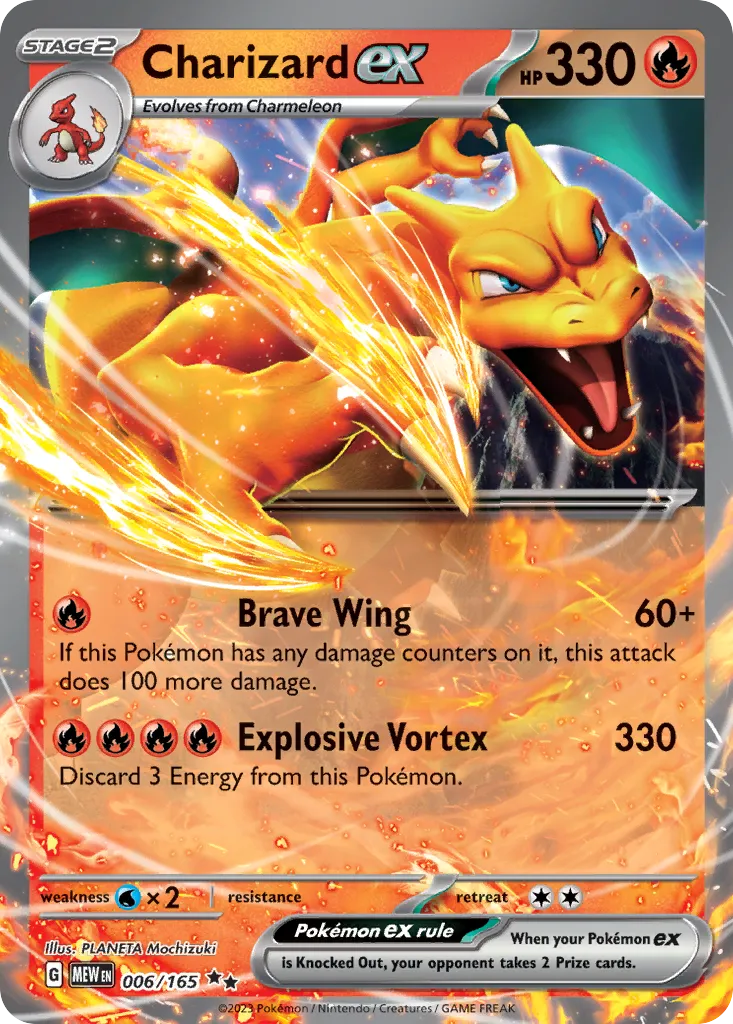
Double Rare (006/165)
- Set
- 151
- Number
- 006/165
- Rarity
- Double Rare
Market price via TCGplayer (through pokemontcg.io); graded values via Scrydex. Card image via pokemontcg.io. CardOps is an independent tool, not affiliated with any publisher, marketplace, or grading company.
Almost every table that sells Pokemon singles has a 151 Charizard ex in it somewhere. The trap is that two very different cards answer to that name, and only one of them is a seven dollar card.
Charizard ex from Pokemon 151 is a modern card that buyers ask for constantly, which makes it a useful piece of stock and an easy one to misprice. The standard Double Rare printing, 006/165, is a volume card. The special illustration rare from the same set trades in a completely different bracket. Knowing which one is in your case, and what it is actually doing this month, keeps a routine sale from turning into a bad one.
What the card actually is
Pokemon 151 is the Scarlet and Violet era set built around the original Kanto lineup, so it draws buyers who stopped collecting decades ago and came back for the nostalgia. Charizard ex sits at number 006/165 in that set, printed as a Double Rare with the standard full-body ex artwork and a foil treatment across the card face.
It is not a short print and it is not a secret rare. Product from 151 has been widely opened since release, so supply on the base Double Rare is deep. That is exactly why it is worth stocking: it is the card a walk-up buyer recognizes, at a price point they will pay without thinking about it.
Base printing versus the special illustration rare
This is the distinction that costs vendors money. The same set contains a Charizard ex special illustration rare, numbered above the 165 printed total, with completely different artwork and a completely different market. Buyers and sellers alike will say "the 151 Charizard" and mean either one.
Check the number in the bottom corner before you quote anything. Two more habits that save you:
- Log the exact card number in your inventory, not just the name, so a search at the table returns the right price.
- Treat online listings with suspicion when the photo and the title disagree. Mislabeled listings for this card are common, and a comp pulled from one of them will be off by an order of magnitude.
If you carry both, keep them physically separated in the case. Nobody negotiates well while re-reading a card number under show lighting.
Where the number sits right now
As of 11 August 2026, a raw holofoil copy carried a TCGplayer market price of about $7. That figure had drifted down roughly 18 percent over the previous thirty days, which is normal behavior for a heavily opened modern card outside of a hype cycle.
Graded copies live on a separate scale. Scrydex put the PSA 10 market estimate near $142 on the same date. Read that as a smoothed estimate rather than a recorded sale: graded estimates lag sudden movement in both directions, and a single hot auction does not reset the number. The snapshot above is a dated reference point for a raw copy, not a live quote.
How condition and grading move it
On a card with a raw value in single digits, condition matters less for the sale in front of you and more for the decision of whether to grade at all. A Near Mint copy and a lightly played copy will trade within a couple of dollars of each other at a table. The real spread opens at the top of the grading scale.
Run the arithmetic before you send anything in. Grading fees plus shipping and turnaround on a $7 card mean you are betting the whole submission on a 10. A 9 on this card does not come close to covering the cost, and the population at 9 is already large. Grade it only when the copy is genuinely clean on centering, edges, and surface, and when you are submitting enough cards to make the per-card cost sensible.
If you want that call made before you pay for it, CardOps has a camera-based Grade Estimator that gives a condition and grade read, including a PSA 10 likelihood, on the device. It is an estimate, not an appraisal, but it is enough to keep marginal copies out of a submission.
Pricing and selling it at a show
At this price this is a volume card, so treat it like one. Sleeve it, keep it in a bin or a case row where buyers can find it without asking, and price it to move rather than to peak. A few working rules:
- Anchor to recent sales for the exact printing and condition, not to the highest active listing.
- Do not spend five minutes negotiating over a single at this tier. Bundle it into a larger sale instead and protect the margin on the whole basket.
- Record your cost when you buy it, in the lot or singly. Two dollars of drift on a card like this is invisible until it repeats across a hundred sales.
A scanner that matches the card and attaches a current market value takes the lookup out of the conversation entirely, which is the difference between a thirty second sale and a two minute one when there is a line behind the buyer.
Questions dealers ask
Is the price above current?
No. It is a dated market reference from the date shown, not a live quote. Check recent sales for the exact printing and condition before you buy or sell.
Why do I see this card listed for hundreds of dollars?
Almost always because the listing is for the special illustration rare from the same set, or for a graded copy, rather than a raw 006/165 Double Rare. Confirm the card number and whether the copy is graded before you use a listing as a comp.
Is it worth grading?
Rarely, at this raw value. Grading fees plus shipping usually exceed what anything below a 10 returns, and the graded population is already deep. Submit only visibly clean copies, and only as part of a batch where the per-card cost makes sense.