
Card spotlight
Pikachu (Base): What It Is and What It's Worth
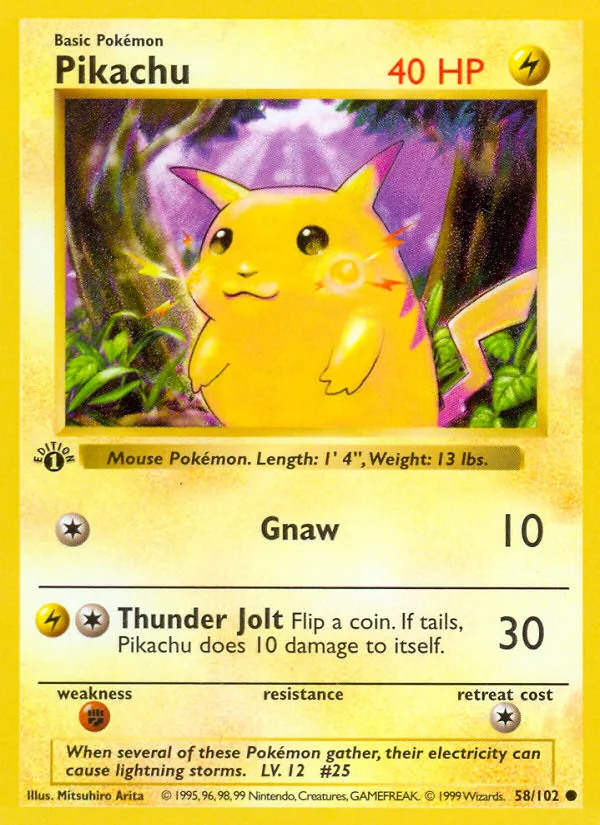
Base Set 58/102
- Set
- Base
- Number
- 58/102
- Rarity
- Common
Market price via TCGplayer (through pokemontcg.io); graded values via Scrydex. Card image via pokemontcg.io. CardOps is an independent tool, not affiliated with any publisher, marketplace, or grading company.
No card gets picked up off a show table more often than Base Set Pikachu. It is also the card most likely to start an argument about price, because there is no single Base Set Pikachu.
Pikachu 58/102 is a common from the 1999 English Base Set. It is not a chase card in the way an alt art is, but it moves constantly, it draws people to the table who were not planning to buy anything, and the spread between the cheapest copy and the most expensive one is wider than on almost anything else in the set. Knowing which printing is in front of you is most of the job.
What the card actually is
It is a non-holo common in the original English Base Set, printed in enormous quantities across several waves between 1999 and 2000. Supply is not the constraint here. Demand is broad and permanent: it is the mascot, it is the card a parent recognizes, and it is the one a lapsed collector asks for by name when they wander past your case.
As of 13 August 2026, a raw copy of the standard non-holo print carried a TCGplayer market price of about $13. Treat that as a dated reference point for the common printing, not a live quote and not a ceiling. It is the number the ordinary copy trades near, and it is the floor from which everything else on this list departs.
Why one Pikachu is worth ten of another
Four things separate copies that look identical at a glance:
- 1st Edition. A small stamp on the left side of the artwork. The earliest and scarcest print run, and the largest single multiplier on this card.
- Shadowless. No drop shadow along the right edge of the art box, thinner border, lighter overall look. Scarcer than the standard run.
- Unlimited. The everyday copy, with the shadow present. This is what most people bring you.
- Red cheeks vs yellow cheeks. The earliest printings show red cheek patches; later ones are yellow. On the early prints this is a real price signal, not trivia.
There are also stamped promotional versions of this card floating around from events of the era. They are separate products with their own market, so never price one off a Base Set comp.
The practical rule: before you quote anything, check the stamp, check the shadow, check the cheeks. A buyer who hands you a shadowless red cheeks copy and takes an unlimited price for it will find out later, and you will hear about it at the next show.
How condition and grading move it
On a raw copy in the low teens, condition is worth a few dollars either way. Near Mint against lightly played is a conversation, not a negotiation. What changes the math entirely is the combination of an early printing and a high grade. Gem copies of 1st Edition and shadowless prints trade for multiples of the raw number, and the graded population at the top is small relative to how many of these cards exist.
That gap cuts both ways. The graded population at 8 and 9 is deep, so a mid grade on an unlimited copy rarely covers submission cost. Do the arithmetic before you send anything: fees plus shipping plus turnaround, against what a 9 actually sells for on that exact printing. If the answer only works at a 10, you are gambling, not investing.
Centering is the usual killer on 1999 WOTC cardboard, followed by edge whitening on the blue-bordered stock. Check both under good light before you promise anyone anything.
Pricing it at a show
Keep the ordinary copies in a clearly priced binder page or a dollar box tier rather than pulling comps one at a time. Volume cards are not worth per-card negotiation, and a visible price keeps the line moving.
Pull the early printings out of that flow entirely and price them individually against recent sold comps for the exact stamp, shadow, and cheek variant. When you buy, price to the printing you can verify, not the one you hope it is.
This is the sort of card where a scan beats a memory. The CardOps scanner matches a card against a catalog of more than 20,000 Pokemon cards on the device and attaches a market value by set and condition, so the identification and the number arrive together while the buyer is still standing there.
Questions dealers ask
Is the price above current?
No. It is a dated market reference for the standard non-holo printing as of the date shown, not a live quote. Check recent sold comps for the exact printing and condition before you buy or sell.
How do I tell 1st Edition from Shadowless?
1st Edition carries a stamp to the left of the artwork. Shadowless has no stamp but also no drop shadow along the right edge of the art box. Every 1st Edition Base Set card is shadowless; not every shadowless card is 1st Edition.
Is a Base Set Pikachu worth grading?
Usually not, if it is an unlimited copy. The raw value is low and the graded population at mid grades is large. Early printings in genuinely clean condition are a different question and worth running the numbers on.