
Card spotlight
Mewtwo (Base): What It Is and What It's Worth
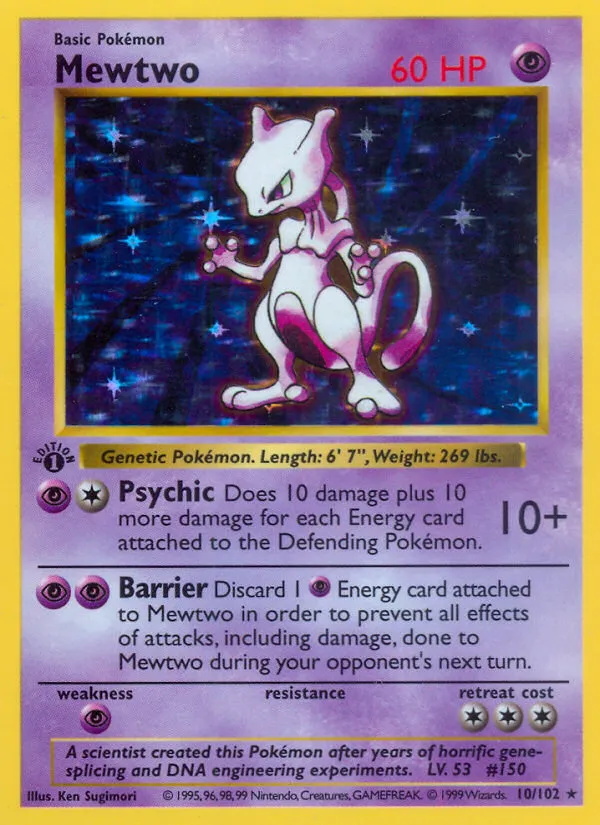
Base Set Holo Rare
- Set
- Base
- Number
- 10/102
- Rarity
- Rare Holo
Market price via TCGplayer (through pokemontcg.io); graded values via Scrydex. Card image via pokemontcg.io. CardOps is an independent tool, not affiliated with any publisher, marketplace, or grading company.
Every vintage table needs a holo that a buyer recognizes on sight and can actually afford. Base Set Mewtwo is usually that card.
Mewtwo 10/102 is one of the sixteen holo rares in the 1999 English Base Set, and it sits in a useful spot for a vendor: famous enough that people stop for it, cheap enough that they can say yes. It will not carry your case the way a Charizard does, but it turns over, and it turns over at a price you can buy right. Here is what the card is, why it holds, and where the real money moves.
What the card is
Mewtwo is a Psychic-type holo rare from the original English Base Set, numbered 10 of 102. Base Set holos were printed in three commercially distinct waves: 1st Edition (which is also shadowless), Shadowless unlimited, and the standard Unlimited run with the drop shadow along the art border. Those are the same artwork and, for pricing purposes, three different cards.
The snapshot above is the aggregate raw holo market, which in practice is dominated by Unlimited copies because that is what most of the supply is. If the card in your hand has no shadow behind the art box, or carries the 1st Edition stamp, stop and price it separately. Assuming Unlimited on a shadowless copy is one of the more expensive mistakes you can make at a vintage table.
Why buyers still ask for it
Mewtwo carries recognition that has nothing to do with the card game. It was the movie villain, the crown jewel of a generation of playground trades, and the name that people who quit in 2001 still remember. That gives it a buyer pool much wider than the collector market: parents, lapsed players, and walk-ups who want one real 1999 holo and do not want to spend four figures on it.
Demand that broad tends to be steady rather than spiky. Over the last 30 days the raw market on this card has been essentially flat, which is what a card looks like when it is being bought by people, not traded by speculators. For a vendor, flat and liquid beats hot and thin.
How condition changes the number
This is a 1999 card that lived in binders, backpacks, and rubber-banded stacks. Very few clean copies survived, and the flaws are predictable. Check the black borders for whitening on all four edges, hold the holo layer to the light for scratches and print lines, and look at centering both left-to-right and top-to-bottom. Base Set holos are notoriously off-center, and it is the first thing a knowledgeable buyer checks.
Price the copy in front of you, not the copy in the price guide. A visibly played Mewtwo is a fraction of the raw market figure above, and a genuinely Near Mint one sits above it. Call the flaws out loud when you sell. A buyer who hears you say "edge wear on the bottom left" trusts the rest of what you tell them.
Where grading changes the scale
Graded Base Set Mewtwo does not trade on the same scale as raw, and the gap at the top is not a percentage, it is a multiple. A high-grade slab is a different product with a different buyer, and the jump between the top two grades is where most of that value lives. That is why we are not printing a graded figure next to the raw one here: putting them side by side makes them look comparable, and they are not.
Practically, this means two things at your table. First, do not price a raw copy by looking at slab sales, which is the most common way dealers talk themselves into overpaying. Second, if a raw copy comes across your table looking genuinely clean and well centered, the grading question is worth asking before you put it in the case at raw money.
Pricing it at a show
Work from recent sold comps for the exact printing and condition, then set a floor before the first buyer walks up. On a card in this range the negotiation is usually friendly and fast, which is exactly when people give away margin they did not mean to give. Knowing your cost and your walk-away number turns that into a two-second decision.
This is the kind of card where a phone beats a binder and a notebook. In CardOps, the scanner matches a card against its Pokemon catalog and attaches a live market value, and Show Mode lets you sell, trade, and buy from the table while per-show profit totals as you go. It keeps working when the convention wifi does not, which is the condition most show floors are actually in.
Questions dealers ask
Is the price above a live quote?
No. It is a dated TCGplayer market reference for a raw holo as of the date shown, not a live quote and not a maximum. Check recent comps for the exact printing and condition before you buy or sell.
How do I tell a Shadowless copy from Unlimited?
Look at the right and bottom edges of the artwork box. Unlimited copies have a drop shadow there; Shadowless copies do not. Shadowless cards also tend to read slightly lighter overall and have a thinner font on the HP. 1st Edition copies are shadowless and carry the edition stamp on the left side of the art.
Is Base Set Mewtwo worth grading?
It depends entirely on the copy. Grading fees and turnaround only pay off on cards that look clean and well centered before they go in, and on this card the return is concentrated in the top grades. Assess honestly, and treat any grade estimate as an estimate rather than a guarantee.