
Card spotlight
Sylveon VMAX (Evolving Skies): What It Is and What It's Worth
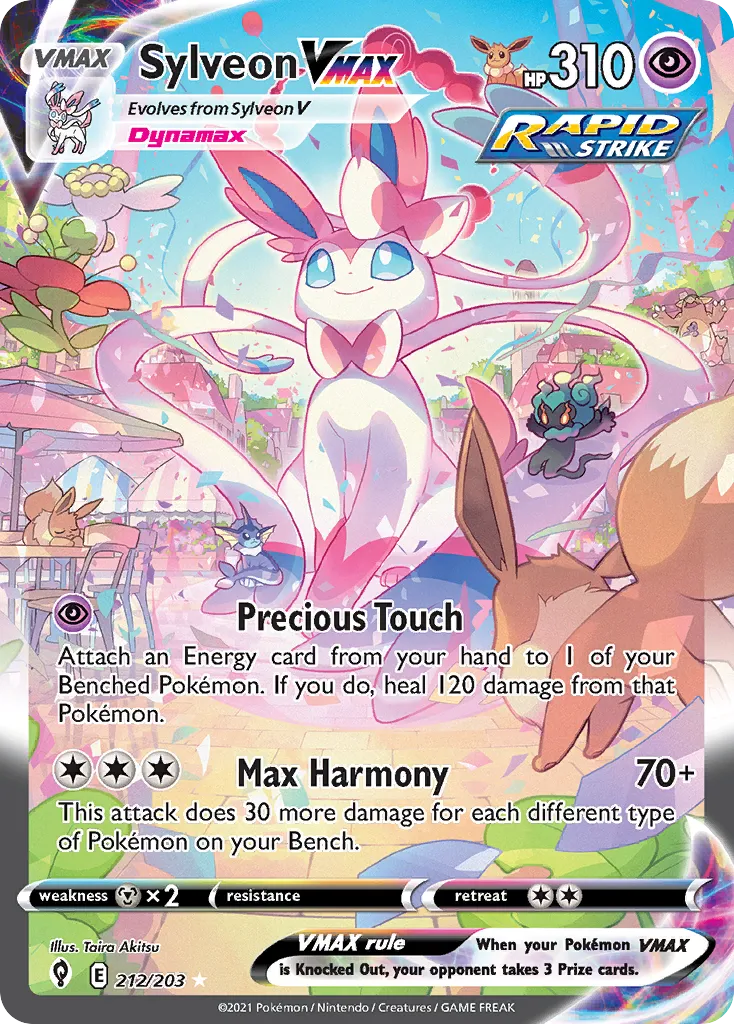
Alternate Art Secret Rare
- Set
- Evolving Skies
- Number
- 212/203
- Rarity
- Secret Rare (Alternate Art)
Check prices: eBay sold · TCGplayer
CardOps may earn a commission on purchases made through these links.
Market price via TCGplayer (through pokemontcg.io); graded values via Scrydex. Card image via pokemontcg.io. CardOps is an independent tool, not endorsed by any publisher or grading company.
Every Evolving Skies case has one Eeveelution alt art that draws a crowd and another that quietly does the work. Sylveon VMAX is the second kind, and it is a better card to stock than its reputation suggests.
The Sylveon VMAX alternate art is one of the Eeveelution secret rares that made Evolving Skies the most hunted Sword and Shield set of its era. It lives in the shadow of the Umbreon alt art, which is exactly why it is worth understanding on its own terms. Buyers who cannot stretch to Moonbreon money still want an alt art Eeveelution in their case, and this is usually the card they land on.
Here is what the card actually is, what the current market snapshot says, and how to price it when someone is standing at your table waiting for a number.
What the card is
Sylveon VMAX 212/203 is an alternate art secret rare from Evolving Skies, the Sword and Shield set built around the Eeveelutions. Its number sits above the printed set total of 203, which is the tell for a secret rare: it is pulled from the same packs but sits outside the numbered set.
Alternate art means the illustration is not the standard VMAX treatment. The full frame is given over to artwork rather than to a game-piece layout, which is the reason these cards get sleeved and cased instead of played. Two practical notes for your inventory:
- It is a single printing. There is no first edition or shadowless split to sort out, so condition and grade carry the whole spread.
- It is one of several alt arts in the set. Buyers often compare across the Eeveelutions in the same breath, so know roughly where each one sits before you quote.
Why it stays in demand
Three things keep this card moving years after the set left print. The Eeveelutions are one of the few Pokémon families that collectors chase as a set, so a case with a gap in it is a case someone wants to fill. The artwork reads as art, which brings in buyers who never played a game of Pokémon. And Evolving Skies is a set that people opened hard and then kept opening, which built a broad base of collectors who all learned the same short list of cards to want.
The point for a vendor is that demand here is steady rather than spiky. This is not a card that needs a news cycle to sell. It sells because someone is partway through the Eeveelution run and wants the next one.
What the snapshot says
The figure above is a dated TCGplayer market reference for a raw copy, not a live quote and not the highest listing on the internet. Read it as the middle of where clean copies have been trading, then check current comps before you commit real money.
Two things worth reading alongside it. The 30-day trend on this printing was essentially flat at the time of the snapshot, which matches how the card has behaved generally: slow and steady rather than volatile. And the graded side is closer to raw than most people assume. The PSA 10 market estimate sat around $668 against the raw figure above, roughly 1.7 times raw. That is a narrower gap than dealers tend to assume for a modern chase card. That estimate is a smoothed market number from Scrydex, not a sale, and it can lag a hot week in either direction.
A modest graded multiple is useful information, not bad news. It tells you the raw copy is where most of the value already sits, and that a submission has to clear grading fees and months of wait against a spread that is not especially generous.
How condition and grading move the number
On a card with a dark border and a large flat illustration, the flaws that cost money are the ones you can see under decent light:
- Centering. The frame makes an off-centre print obvious, and graders are unforgiving about it on modern cards.
- Edge whitening. Dark borders show every nick. Check all four edges with the card flat, not held up.
- Surface. Scratches on the foil catch the light at an angle. Tilt it before you quote.
Grading changes the scale but not the logic. The population on this card is large, with more than 14,000 copies already in a PSA 10 at the time of this snapshot, which is a big part of why the graded premium is moderate. Plenty of supply at the top grade means a gem copy is a good card, not a rare event.
If you buy raw and submit, run the arithmetic first: grading cost, shipping, insurance, and the months your cash is tied up, all against a spread of roughly a few hundred dollars if the card grades a 10 and considerably less if it does not. On this particular card, buying it right and selling it raw is often the cleaner trade.
Pricing it at a show
Anchor to recent sold comps for this exact printing and condition. Optimistic asks cluster around any card with a following, and a listing price is not a comp. Then decide your floor before the conversation starts, because a card in this range is exactly where a friendly negotiation quietly costs you the margin.
Keep the graded figure in your head as context, not as your ask on a raw copy. A buyer who opens with "but PSA 10s go for double" is comparing two different products, and the honest answer is that they are welcome to pay grading fees and wait.
Practical habits that hold up at a busy table:
- Record your cost the day you buy it, not the day you sell it.
- Write the condition down in plain words, so future you knows why this copy was priced under the last one.
- Quote raw against raw comps, and say out loud that the card is ungraded.
If you want the graded number next to the raw one while you are standing at the table, CardOps shows graded PSA and CGC prices alongside live market value on Pro, so the comparison is one screen rather than three browser tabs. More on how the tiers split is on the free vs Pro page.
Questions dealers ask
Is the price above current?
It is a dated market reference as of the date shown, not a live quote. Always check recent comps for the exact printing and condition before you buy or sell.
Is Sylveon VMAX alt art worth grading?
Run the numbers on the specific copy. The graded premium on this card is moderate, roughly 1.7 times raw at the time of this snapshot, and the PSA 10 population is large. A visibly clean, well centred copy can be worth submitting; a card with any edge wear usually is not.
How does it compare with the Umbreon VMAX alt art?
Umbreon is the headline card of the set and trades well above this one. Sylveon is the more accessible alt art, which is often why it sells: a buyer who wants an Eeveelution alt art in the case without the top-of-market price lands here.
Are there different printings to watch for?
No. This card exists as a single alternate art secret rare printing, so condition and grade account for the whole price spread.