
Card spotlight
Dark Charizard (Team Rocket): What It Is and What It's Worth
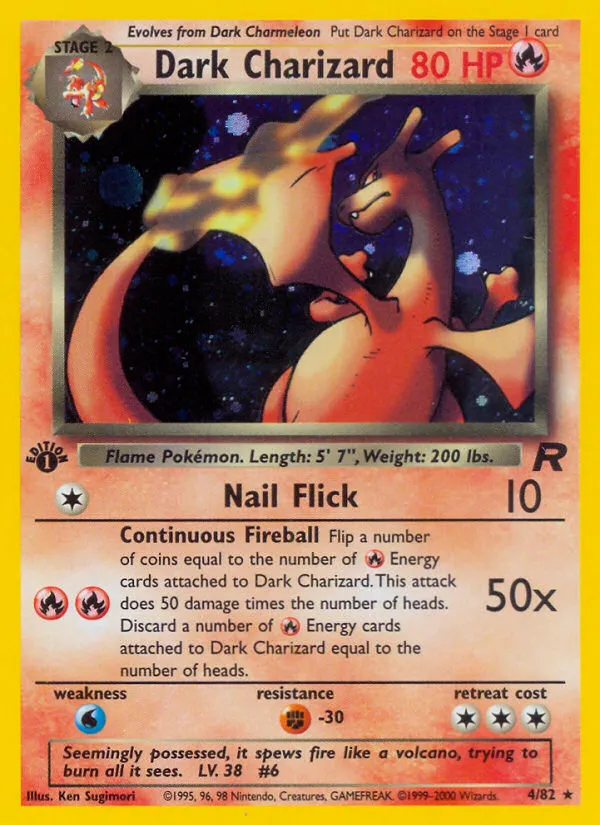
Holo Rare, 2000 Team Rocket
- Set
- Team Rocket
- Number
- 4/82
- Rarity
- Rare Holo
Check prices: eBay sold · TCGplayer
CardOps may earn a commission on purchases made through these links.
Market price via TCGplayer (through pokemontcg.io); graded values via Scrydex. Card image via pokemontcg.io. CardOps is an independent tool, not endorsed by any publisher or grading company.
Team Rocket is the set where a lot of vintage buyers start once Base Set prices them out, and Dark Charizard is the card they ask for by name. Here is what it is and how to price it at your table.
Dark Charizard 4/82 came out of the 2000 Team Rocket set, the one that turned familiar Pokemon into their corrupted counterparts. It has the Charizard name, a distinct piece of artwork that nobody confuses with Base Set, and enough surviving supply that a working dealer can actually keep one in the case. That combination is why it stays liquid at shows while the more expensive vintage chases sit.
The number in the panel above is a dated market reference for one specific printing, not a live quote and not a ceiling. The rest of this page is the context you need to use it.
What the card actually is
Team Rocket shipped in April 2000 as the fourth English Wizards of the Coast set. Its hook was the Dark mechanic: existing Pokemon reprinted as Team Rocket versions with darker art and meaner attacks. Dark Charizard sits at number 4 of 82 as a holo rare, and it is the card most people picture when the set comes up.
Two things make it a different proposition from a Base Set Charizard. Print runs by 2000 were much larger than they were in 1999, so raw copies come to market regularly. And the artwork stands on its own rather than reading as a second-tier version of something else, which matters to collectors who already own or gave up on the Base Set card.
The printings are different cards commercially
This is where dealers lose money on Dark Charizard, so get it right before you buy one.
- 1st Edition holo (4/82) carries the 1st Edition stamp on the left side of the artwork. It is the scarce printing and it trades at a premium over unlimited. How large that premium is moves with condition and with the vintage market generally, so check it fresh rather than applying a fixed multiplier.
- Unlimited holo (4/82) has no stamp. This is the printing the snapshot above quotes, and it is the one you will see most often in a bulk buy or a collection walk-up.
- Non-holo Dark Charizard (21/82) is a separate card in the same set, a plain rare rather than a holo. It is worth a small fraction of either holo. Buyers who only half remember the set genuinely confuse the two, and so do sellers pricing a collection they inherited.
Check the stamp and check the number before you quote anything. A card listed as "Team Rocket Dark Charizard" tells you almost nothing on its own.
Why it keeps selling at shows
Every table needs cards in the tier between the twenty dollar singles and the slab in the locked case. Dark Charizard sits there comfortably. It is a recognizable name at a price a serious collector can decide on in one conversation, which is exactly the kind of card that closes at a show rather than going home in the box again.
It also holds attention. A raw holo in a top loader gets picked up, and a card that gets picked up gets asked about. That is worth something on a slow Sunday even when it does not sell.
On the current snapshot, the unlimited holo has been roughly flat over the last 30 days. A card that moves sideways is easy to stock: your cost basis stays meaningful for weeks rather than being overtaken between shows.
How condition and grading move the number
Twenty five year old holos are rarely clean. The usual damage is edge whitening on the black borders, surface scratching across the holo layer, and centering that was never good to begin with. Any of those can take a copy from a comfortable sale to a card you are explaining apologetically.
The snapshot above is a raw reference. Graded copies trade on a completely different scale, and the spread between grades on a vintage Charizard is steep enough that a single point at the top end changes the number by multiples. That is why the panel quotes raw only: a graded figure attached to a raw card is a misleading comparison, not a bonus data point.
Two practical rules. Grade it honestly at the table and say the flaw out loud before the buyer finds it, because on vintage they always find it. And when you are weighing whether a raw copy is worth submitting, price the grading fees and the wait into the decision rather than assuming the top grade. CardOps has a Grade Estimator that gives a camera-based condition read before you pay for a submission, and it is an estimate rather than an appraisal, which is the right way to use any pre-grade opinion.
Pricing it at your table
Work in this order:
- Identify the exact printing. Stamp, card number, holo or not. Everything downstream depends on this.
- Anchor to recent sold comps for that printing and that condition, not to the highest active listing. Vintage Charizards attract optimistic asks from people who are not actually selling.
- Set your floor before the negotiation starts. Know your cost, your fees, and the number below which you would rather keep the card. On a three figure single, one soft trade eats the margin from a lot of common sales.
- Record the sale against the show, so the card shows up in that show's profit rather than disappearing into a general total.
CardOps handles the last part in Show Mode: search inventory, ring the sale, and watch the show's profit update live, offline if the hall wifi is gone. The scanner matches a card against a catalog of more than 20,000 Pokemon cards and attaches a live market value by set and condition, which is faster than typing "Dark Charizard" into a phone browser while somebody waits.
Questions dealers ask
Is the price above current?
It is a dated market reference for the raw unlimited holo as of the date shown, not a live quote. Vintage prices move. Check recent comps for the exact printing and condition before you buy or sell.
How do I tell 1st Edition from unlimited?
Look for the 1st Edition stamp on the left side of the artwork, below the image. No stamp means unlimited. The stamped copies are the scarce printing and trade at a premium.
Is the non-holo Dark Charizard worth anything?
Card 21/82 is a plain rare from the same set and trades for a small fraction of the holo. It is a real card worth stocking at the right cost, just not at holo money. Confirm the number before you quote.
Should I grade a raw copy?
Only if the card can realistically hit a grade where the premium clears the fee and the wait. On a twenty five year old holo, centering and surface usually decide that before you ever mail it.