
Card spotlight
Pikachu VMAX (Vivid Voltage): What It Is and What It's Worth
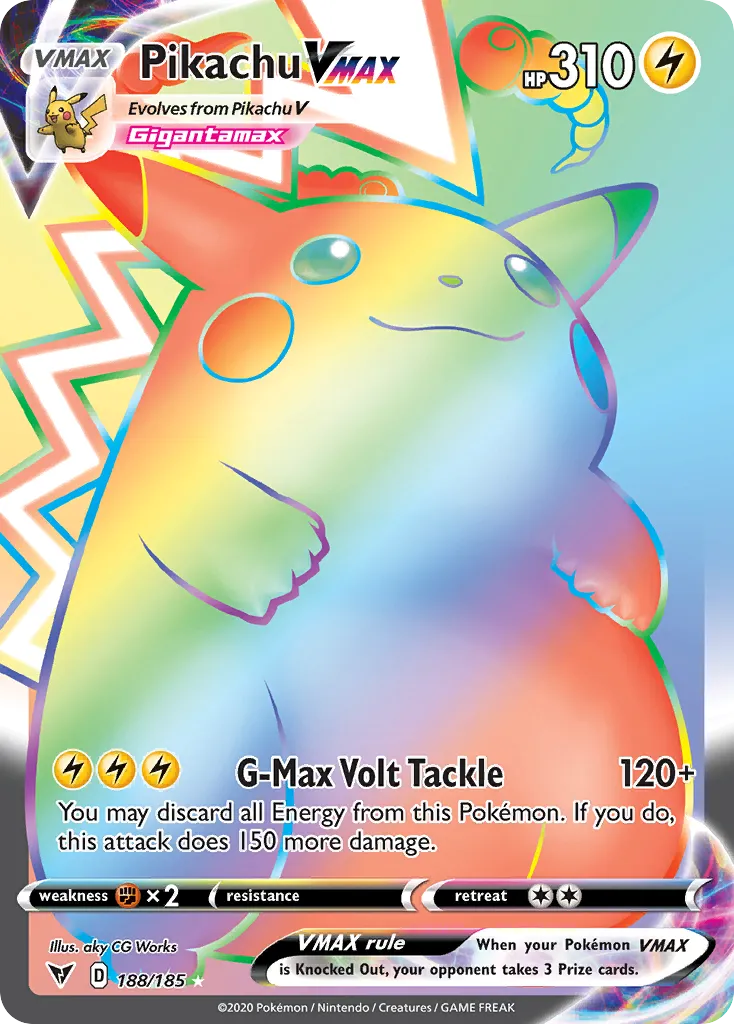
Rainbow Rare Secret Rare
- Set
- Vivid Voltage
- Number
- 188/185
- Rarity
- Rare Rainbow (Secret Rare)
Check prices: eBay sold · TCGplayer
CardOps may earn a commission on purchases made through these links.
Market price via TCGplayer (through pokemontcg.io); graded values via Scrydex. Card image via pokemontcg.io. CardOps is an independent tool, not endorsed by any publisher or grading company.
Vivid Voltage was opened by nearly everyone, and this is the card they were opening it for. Here is what the Rainbow Rare Pikachu VMAX actually is, and how to price one when a buyer puts it on your table.
Pikachu VMAX 188/185 is one of the few modern Secret Rares that a walk-up customer can name without looking it up. That recognition cuts both ways for a vendor. It moves fast in a case, and it also means the buyer standing in front of you has probably checked a price on their phone before they asked. Knowing the printing, the supply picture, and where condition takes the number keeps you on solid ground in that conversation.
What the card actually is
Vivid Voltage was the Sword and Shield era set released in November 2020, with a printed total of 185 cards. Anything numbered above that total is a Secret Rare, and 188/185 is the Rainbow Rare treatment of Pikachu VMAX: the oversized Gigantamax artwork rendered in the pastel rainbow foil the era used for its top rarity slot.
Two details matter when you are sorting a bulk buy. First, there is a separate, far more common Pikachu VMAX in the set at 044/185, and it is not this card. Check the number in the corner before you price anything. Second, the Rainbow printing exists as a holofoil only, so there is no non-foil variant to confuse it with. If it is 188/185, it is the chase.
Why it stays a chase card
The demand side is the easy part. Pikachu is the most recognizable character in the hobby, the Gigantamax artwork is the version most people picture, and Vivid Voltage sat in every big-box store during a period when a lot of new collectors entered the hobby. That produces a card people ask for by name years after release.
The supply side is the part dealers underrate. Vivid Voltage was printed heavily and reprinted, so this is not a scarce card in absolute terms. What holds it up is that the demand base is unusually broad, not that copies are hard to find. Practically, that means it behaves like a liquid staple rather than a card that spikes. You can expect to sell one at most shows, and you should not expect to buy one cheap.
What the snapshot above says, and what it does not
The figure in the price block is the TCGplayer market price for a raw holofoil copy on the date shown. It is a dated reference point, not a live quote and not a ceiling. Over the thirty days ending on that snapshot the market number moved by about one percent, which is another way of saying it did not move. A flat month on a card this liquid is normal and is useful information: there is no run to chase and no slide to get ahead of.
Graded copies trade on a separate scale. On the same snapshot the smoothed PSA 10 market estimate sat at roughly $328. Treat that as an estimate rather than a sale. It is a modelled figure that can lag a hot week in either direction, and it is not what a specific copy sold for.
How condition and grading move the number
Rainbow Rares from this era show wear in predictable places. The pastel foil surface picks up print lines and scratches that only appear when you tilt the card under light, and the dark border edges show whitening from a single rough pull. Look at both before you commit to a buy price, not after.
Grading is where dealers talk themselves into bad math on this card. At the time of this snapshot PSA's population report listed roughly 12,000 copies in PSA 10 and about 5,500 in PSA 9, so a gem copy is not a rare object. Combine that with a PSA 10 estimate under twice the raw number and the arithmetic is unforgiving: grading fees, shipping, and months of turnaround have to come out of a gap that is not very wide, and a 9 puts you underwater. This is a card to buy and sell raw unless you are already sending a submission and have a copy that is genuinely clean.
If a customer brings you a slab, price the slab on its own comps. A graded copy is a different item from the raw card in your case, and the snapshot above tells you nothing useful about it.
Pricing it at your table
Set your number before the show, from recent sold comps for 188/185 in the condition you actually have, and write it down with your cost next to it. A card this recognizable attracts confident negotiation, and the moment to decide your floor is not while somebody is standing there with cash out.
Two habits keep you honest on it. Price the condition in front of you rather than the condition you paid for, and quote your own number first instead of reacting to the listing a buyer pulls up, since asking prices on a well-known card skew high. If you are running CardOps at the table, having the cost basis and your floor on the card record means the negotiation happens against real margin instead of memory.
The takeaway for the next show: treat this one as reliable turnover, not as an investment position. It sells, it sells at a predictable number, and the money is made on what you paid for it.
Questions dealers ask
Is the price shown current?
No. It is the TCGplayer market price for a raw holofoil copy as of the date printed in the block above, not a live quote. Check recent sold comps for the exact number and condition before you buy or sell.
Is this the same as the Pikachu VMAX at 044/185?
No. 044/185 is the standard VMAX from the main set and is worth far less. The Rainbow Rare is 188/185, above the set's printed total of 185. Always read the number before pricing.
Is it worth grading?
Usually not, on the figures in this snapshot. The PSA 10 estimate sat under twice the raw market price while the PSA 10 population was already around 12,000 copies, so grading fees and turnaround eat most of the spread and a PSA 9 leaves you behind. Grade only a visibly clean copy, and only if you are submitting anyway.
Why do listings online show much higher numbers?
Asking prices are not sales. On a card people recognize by name, optimistic listings sit unsold for a long time. Price against what copies actually sold for in the last few weeks.