
Card spotlight
Rayquaza VMAX (Evolving Skies): What It Is and What It's Worth
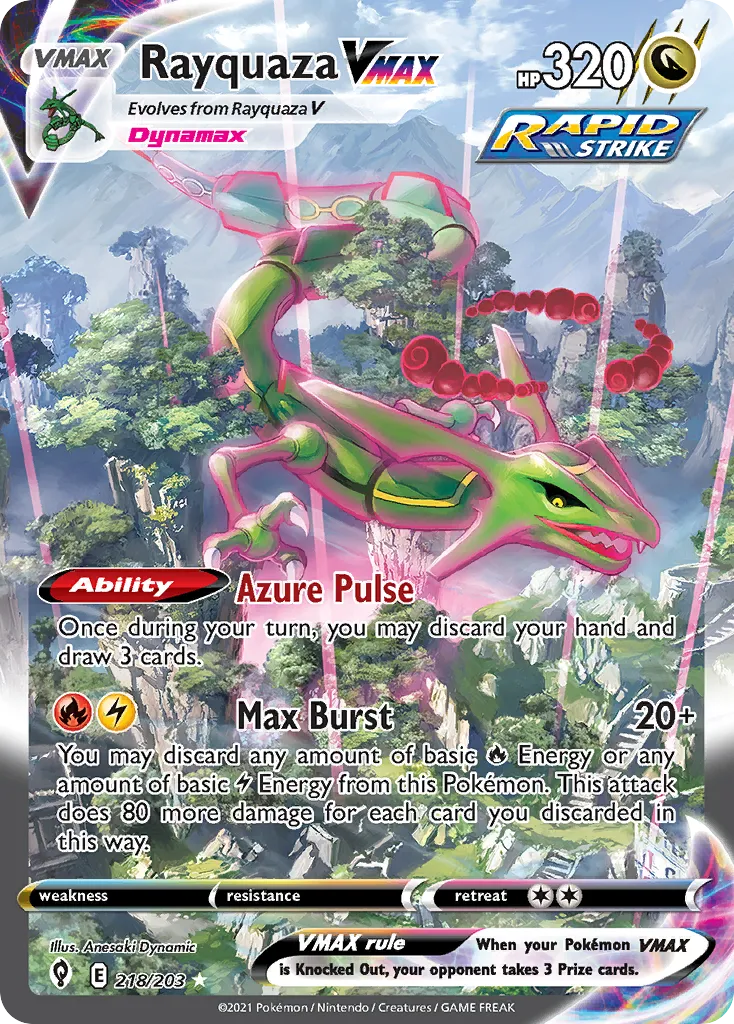
Alternate Art Secret Rare
- Set
- Evolving Skies
- Number
- 218/203
- Rarity
- Secret Rare (Alternate Art)
Market price via TCGplayer (through pokemontcg.io); graded values via Scrydex. Card image via pokemontcg.io. CardOps is an independent tool, not affiliated with any publisher, marketplace, or grading company.
Evolving Skies is best known for the Eeveelution alt arts, but the secret rare that closes out the set out-prices most of them. Here is what the Rayquaza VMAX alt art is and how to think about its value at your table.
The Rayquaza VMAX alternate art from Evolving Skies sits at the top of the set's secret rare run, and it prices like it: a raw holofoil copy runs well over a thousand dollars in today's market, with graded copies moving in a completely different range. If you carry vintage-adjacent modern chases, this is a card worth knowing cold before it lands in your case.
What makes it a chase card
Rayquaza is a fan-favorite legendary, the alt art treatment turns the VMAX into a full-bleed illustration rather than a standard frame, and the Secret Rare slot keeps print supply tight relative to demand. Evolving Skies also happens to be one of the most opened sets of its era, so the card is well known even to buyers who don't usually chase secret rares. That combination of recognizability and scarcity is why it holds a premium well after the set's release.
How condition and grade move the number
This is a card where the gap between raw and graded is stark. A raw holofoil copy trades in the low four figures, but a PSA 10 has recently sold well into five figures, and even a PSA 9 clears six figures on the resale market for the rarest pop reports. That spread means centering, edge wear, and surface scratches on a full-art print are not cosmetic nitpicks, they are the difference between a strong raw sale and a card worth sending to a grading company. Grade it honestly at the table and price a raw Near Mint copy near the top of your raw range, not the graded range.
Pricing it at a show
Anchor to recent sold comps for the exact printing and condition, not to the highest active listing you can find. A card at this price point attracts optimistic asks from both buyers and sellers, so your job is to price to what it actually clears, not what someone hopes it clears. The market has also drifted up modestly over the past month rather than swinging hard either direction, so a dated snapshot from a few weeks back is still a reasonable starting point, just verify against current comps before you commit real money.
Where it fits in your case
A card like this is a centerpiece, not a bin item. Keep it in a hard sleeve or slab, know your cost and floor before you set it out, and be ready to walk a buyer through why the price is what it is: the alt art, the secret rare slot, and the condition in hand. Recording the cost basis and sale in CardOps the moment it moves keeps your per-show numbers honest on a card this size, where a single sale can swing the whole day's total.
Questions dealers ask
Is the price above current?
It is a dated market reference as of the date shown, not a live quote. High-value cards like this one move with the broader market, so always check recent comps for the exact printing and condition before you buy or sell.
Does grading change what it's worth?
Yes, dramatically. A PSA 10 copy of this card has recently sold for well over ten times the raw market price. The snapshot above is a raw, ungraded reference point, not a graded one.
Is this the only Rayquaza VMAX printing from Evolving Skies?
No. Evolving Skies also includes a standard non-alt-art Rayquaza VMAX at a much lower price point. Confirm the card number, 218/203, before you price it as the alternate art.