
Card spotlight
Jungle Snorlax 11/64: What It Is and What It's Worth
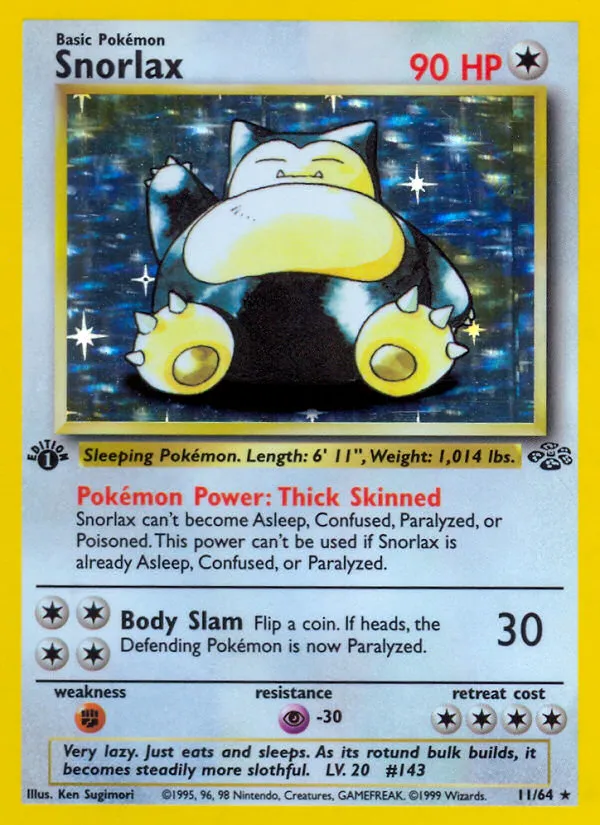
Jungle Holo Rare
- Set
- Jungle
- Number
- 11/64
- Rarity
- Rare Holo
Check prices: eBay sold · TCGplayer
CardOps may earn a commission on purchases made through these links.
Market price via TCGplayer (through pokemontcg.io); graded values via Scrydex. Card image via pokemontcg.io. CardOps is an independent tool, not endorsed by any publisher or grading company.
Jungle Snorlax is the card a certain age of buyer walks straight to. It is also the card that costs dealers money, because two copies that look identical in a binder page can be worth twice as much apart.
Snorlax 11/64 is the headline holo of the 1999 Jungle set, and it has stayed there through every vintage cycle since. For a vendor that makes it easy stock to move and easy stock to misprice. The difference between the two Jungle print runs is not cosmetic, it is commercial, and the buyer standing at your table almost always knows which one they are holding. Here is what the card is, what the current market snapshot says, and how to price it without leaving money on the table or overpaying on a buy.
What the card is
Snorlax is number 11 in Jungle, a 64-card set and the first expansion Wizards of the Coast released after Base Set. It is a Rare Holo, which in that era meant a foil panel behind the artwork and a print run that never came close to the demand it eventually met.
Jungle is a nostalgia set more than a playable one. The people buying it now opened it as kids, and Snorlax is the card most of them remember. That demand is broad and steady rather than spiky, which is exactly the profile a show vendor wants: it does not need a hype cycle to sell, it just needs to be in the case.
Two printings, two different cards
Jungle ran as a 1st Edition print and then an Unlimited print. Commercially they are separate cards, and the gap is not small. In the same snapshot behind the price above, the 1st Edition holo sat at roughly $342 market while the Unlimited holo sat at about $152. Same art, same number, more than double the money.
The tell is the 1st Edition stamp, a small black icon printed to the lower left of the artwork. If it is there, you are holding the scarcer print. If it is not, it is Unlimited. There is no plain unmarked holofoil variant for this card, so any listing, comp, or price you quote has to name which printing it refers to. A comp that does not say is not a comp you can use.
The practical rule at a table: read the stamp before you read the price. Sorting a walk-up collection, that one check is worth more per second than anything else you do with vintage holos.
What the snapshot says
The figure at the top of this page is a dated TCGplayer market reference for a raw Unlimited holo, not a live quote and not a maximum. Market prices are a smoothed read on where recent transactions landed, so they lag a fast-moving day in either direction.
Over the 30 days before that snapshot the Unlimited holo moved about one percent, which is another way of saying it did not move. That is normal for this card and it is useful information. A flat vintage holo means you can price it off a reference without chasing the market daily, and it means a buyer quoting you a number wildly off that reference is either working from a different printing or a different condition.
Check the date on any number before you use it, including this one. A dated reference you trust beats a live-sounding number you cannot source.
Why condition decides most of the value
Wizards-era cards were not cut, centered, or surfaced to modern standards, and Jungle holos in particular pick up edge whitening and foil scratching just from being handled. A copy that reads clean at arm's length often gives up centering or a soft corner the moment it goes under a light.
The population data tells the story plainly. At the time of this snapshot PSA had graded roughly 15,400 copies of this card, and about 115 of them are 10s. That is well under one percent. Nearly four thousand sit at PSA 8 and the counts fall off sharply above it. High grades on this card are genuinely scarce, and that scarcity is where the top of the market lives.
For raw stock at a show, that means two things. Grade honestly and out loud: name the whitening or the centering before the buyer finds it, because on a card this familiar they will. And do not price a played copy off a Near Mint reference. The gap between a clean raw copy and a played one on vintage holos is wide enough to eat a whole day's margin on a single card.
Pricing it at your table
Build the number in this order. Confirm the printing, set condition honestly, then anchor to recent sold comps for that exact printing and condition rather than to the most optimistic active listing you can find. Familiar cards attract optimistic asks, and asks are not sales.
Then know your floor before the negotiation starts, not during it. Record what the card cost you and the lowest number you will take, so a friendly haggle over a $150 card never quietly turns into a loss. That is the part a cash box and a memory handle badly at hour six of a show.
CardOps keeps cost, condition, and live market value on the card itself, so the number you need is on the phone in your hand while the buyer is still standing there. It runs offline, which matters more than it sounds like it should when the hall wifi gives out mid-Saturday.
Questions dealers ask
Is the price shown current?
It is a dated market reference for the date printed above, not a live quote. Vintage holos move slowly but they do move, and the raw market never reflects a graded copy. Check recent sold comps for the exact printing and condition before you buy or sell.
How do I tell 1st Edition from Unlimited?
Look for the small 1st Edition stamp printed to the lower left of the artwork. If it is there the card is from the earlier, scarcer print run and trades well above Unlimited. If there is no stamp, it is Unlimited. Always say which one you mean when you quote a price.
Is it worth grading a raw copy?
It depends on the copy and on your grading costs, not on the card. High grades on Jungle holos are scarce because the print quality of the era makes them scarce, so a copy has to be genuinely clean on centering, edges, and surface to be worth the fee and the wait. Assess it honestly before you send it, and treat any estimate, including an app's, as an estimate rather than an appraisal.
Why do listings for this card vary so much?
Usually because they are not the same card. Different printing, different condition, raw against graded, and each grade trading on its own scale. A price is only meaningful once the printing and the condition are pinned down.