
Card spotlight
Charizard ex 199/165: The 151 Special Illustration Rare
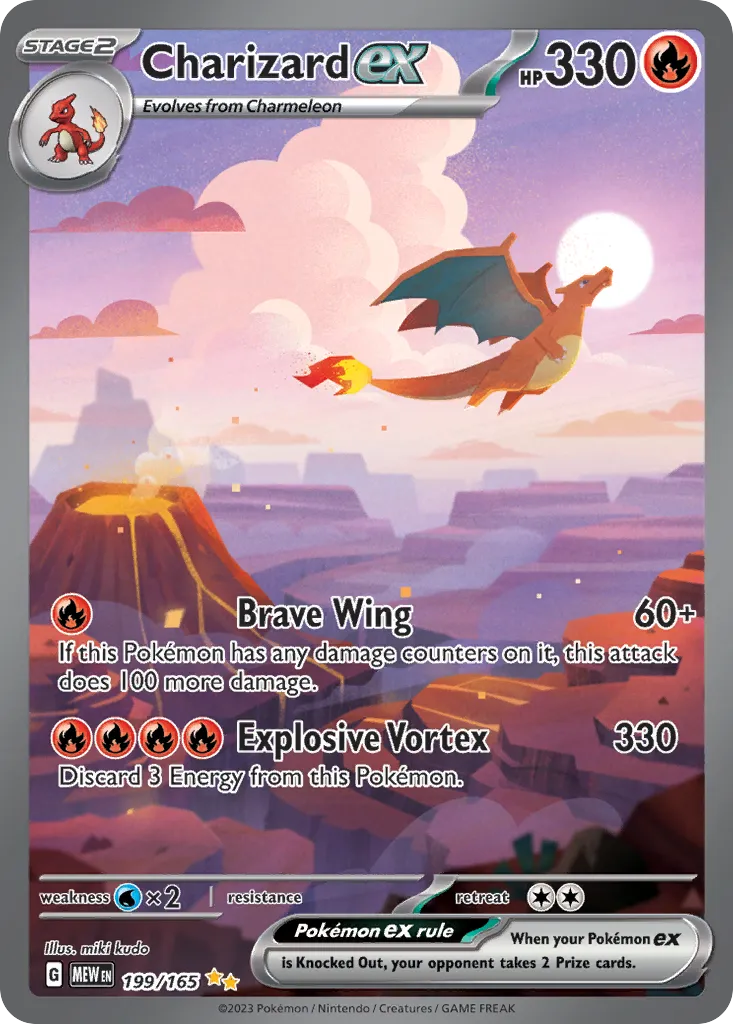
Special Illustration Rare
- Set
- 151
- Number
- 199/165
- Rarity
- Special Illustration Rare
Check prices: eBay sold · TCGplayer
CardOps may earn a commission on purchases made through these links.
Market price via TCGplayer (through pokemontcg.io); graded values via Scrydex. Card image via pokemontcg.io. CardOps is an independent tool, not endorsed by any publisher or grading company.
If you run a table, you already know this one by the crowd it draws. The 199/165 Charizard ex is the card people ask for by number, and it is worth knowing exactly what you are holding before you quote a price.
The Special Illustration Rare Charizard ex from 151 sits at the top of one of the most opened modern sets. That combination, huge print alongside a card almost nobody pulls, is why it keeps showing up in cases and why buyers still stop for it years after release. This page covers what the card is, how its raw and graded markets differ, and how to price it honestly with a line of buyers waiting.
What the 199/165 actually is
151 revisits the original Kanto lineup, and the Charizard ex is its headline card. The set prints to 165, so anything numbered above that is a secret slot pulled at a much lower rate. Card 199 is the Special Illustration Rare: a full-bleed illustration where the artwork runs the whole card rather than sitting in a window, with textured foil across the surface.
Note that there is more than one Charizard ex in this set. The base ex at number 6 is a different card at a very different price, and so is the Ultra Rare printing. When a buyer says "the 151 Charizard," ask for the number before you pull anything out of the case. Misquoting one printing for another is the fastest way to lose money or lose the sale.
Why it stays a chase card
Three things hold it up. Charizard carries demand that no other Pokemon matches, from collectors who buy nothing else and from families who recognize it on sight. The Special Illustration Rare treatment made it the visual centerpiece of the set. And 151 was opened heavily for its lower rarities, which means plenty of supply of everything except this card.
For a vendor, that translates into predictable foot traffic. A copy in the case is a reason for someone to stop walking, and stopping is most of the job. Even when the buyer leaves with a $40 card instead, the Charizard did its work.
Raw versus graded on this card
The dated snapshot above is a raw holofoil reference. Graded copies trade on a different scale entirely: a PSA 10 market estimate for this card sits around $1,464, roughly four times the raw figure. That is an estimate from a graded price service, not a sale you can point to, and hot cards can move well ahead of a smoothed estimate in either direction.
Before you treat that spread as free money, price the path between the two. Grading costs a fee per card plus shipping and insurance both ways, and it costs months of your money sitting still. It only pays if your copy realistically grades at the top. A card that comes back a 9 lands far closer to the raw number than the 10, and centering on full-art cards is unforgiving.
Our guide on graded versus raw stock walks through when that math works for a working vendor.
How condition moves the number
Full-art cards show wear that a bordered card hides. Look for these before you buy or quote:
- Centering, judged on the printed art rather than a border, which is what makes this card hard to grade high.
- Edge and corner whitening, obvious against dark foil under table lighting.
- Surface scratches and print lines, best seen by tilting the card under a light rather than staring at it flat.
- Pack-fresh dents along the top edge from the pack wrapper.
Call the flaw out loud when you show the card. A buyer who hears about the soft corner from you pays your price. A buyer who spots it after the handshake tells other people about it.
Pricing it at a show
Anchor to recent sold prices for the exact printing and condition, not to the cheapest listing or the most hopeful one. On a card with this much attention, asks run high and actual sales run lower, and the two get confused constantly. Our guide on reading comps covers separating the two quickly.
Know your floor before the conversation starts. Record what you paid, decide the lowest number you will take, and hold it. A card at this level almost always comes with a negotiation, and the dealers who lose money are the ones doing the arithmetic in their head while somebody waits.
Watch the direction too. This card has drifted down roughly six percent over the past thirty days, which is normal movement rather than a collapse, but it matters if you bought at last month's number and are still asking last month's price. CardOps tracks market value and trend history by set and condition, so the card in your case has a current number attached rather than the one you memorized at the last show.
Questions dealers ask
Is the price above current?
It is a dated market reference from the date shown, not a live quote. Chase cards move week to week. Always check recent sold prices for the exact printing and condition before you buy or sell.
Which Charizard ex is this?
Card 199 of 165 from 151, the Special Illustration Rare with the full-bleed artwork. It is a different card from the base Charizard ex at number 6 and from the Ultra Rare printing, and the three trade at very different prices.
Is it worth grading?
Only if the copy is genuinely a candidate for the top grade. Centering on full-art cards is strict, grading fees and shipping come out of the spread, and the money is tied up for months. A copy that grades a 9 lands much closer to the raw number than the estimate for a 10.
Where do these numbers come from?
The raw figure is TCGplayer market data through pokemontcg.io, dated above. The graded estimate is a market estimate from Scrydex, not a recorded sale. Neither is a guarantee of what your copy will bring.